Discover how Automated Switch technology simplifies network configuration, improves reliability, reduces manual errors, and supports scalable network automation for modern businesses.
Introduction
Modern enterprise networks are growing in size, complexity, and operational demand, making manual network management increasingly difficult to maintain. Automated Switch Networks help organizations simplify network operations by automating configuration, provisioning, policy enforcement, and routine management tasks across switching environments.
By combining network automation with intelligent workflows and AI-driven capabilities, businesses can improve consistency, reduce manual effort, respond to changes faster, and manage infrastructure more efficiently at scale.
This article explains how Automated Switch Networks work, their key benefits and practical use cases, the role of AI in network automation, common implementation challenges, and the best practices organizations can follow to build a more scalable, reliable, and efficient network infrastructure.
What Is an Automated Switch Network?
Network automation is the use of software, intelligent workflows, and automation tools to manage network devices, configurations, and day-to-day infrastructure tasks with less manual intervention. It can automate activities such as device configuration, deployment, validation, troubleshooting, and network changes across complex environments.
Instead of engineers performing every task manually, automated workflows follow predefined rules and policies to complete repetitive network operations in a more consistent and controlled way. These workflows can be built using scripts, configuration management tools, APIs, or dedicated network automation platforms.
For modern enterprise networks, automation can help teams manage growing infrastructure more efficiently while reducing configuration inconsistencies and operational delays.
Key Benefits of Network Automation
- Greater operational efficiency: Repetitive network tasks can be completed automatically, giving engineering teams more time to focus on planning, optimisation, and complex technical work.
- Reduced configuration errors: Standardised automated workflows help minimise manual mistakes and improve consistency across network devices.
- Faster network changes: Configuration updates, deployments, and infrastructure changes can be carried out more quickly compared with fully manual processes.
- Improved scalability: As networks grow, automation makes it easier to manage large numbers of devices and configurations without increasing manual workload at the same rate.
- Lower operational effort: Reducing repetitive tasks can help organisations use engineering resources more effectively and simplify routine network operations.
- More consistent security controls: Automated workflows can help apply approved configurations and security policies consistently across multiple devices and network environments.
- Better network reliability: Standardised processes and validation steps can reduce configuration drift and help maintain a more predictable network environment.
How AI Automation Works in Switch Networks?
AI automation in switch networks combines intelligent software, network data, and automated workflows to make switching environments easier to manage and more responsive to change. Instead of relying only on fixed rules or manual configuration, AI-powered systems can analyse network behaviour, identify patterns, and support faster operational decisions.
The process usually begins by collecting data from switches, connected devices, traffic flows, configuration files, and network events. AI models can then evaluate this information to detect unusual behaviour, configuration inconsistencies, capacity issues, or potential performance problems.
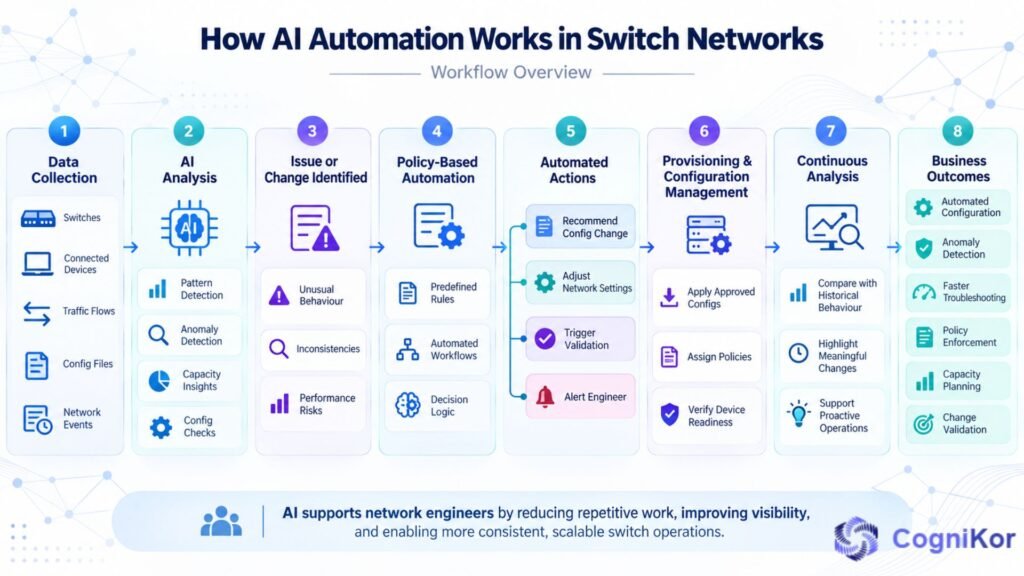
Once an issue or change is identified, automation workflows can take the next step based on predefined policies. For example, the system may recommend a configuration change, adjust network settings, trigger a validation check, or alert an engineer before a problem affects users.
AI automation can also support switch provisioning and configuration management. When new switches are added to the network, automated workflows can apply approved configurations, assign policies, and verify that the device is operating as expected. This reduces repetitive manual work and helps maintain consistent standards across larger environments.
Another important capability is intelligent analysis. AI can compare current network conditions with historical behaviour to highlight changes that may require attention. This helps network teams move from reactive troubleshooting toward a more proactive approach to network operations.
In practical terms, AI automation in switch networks can support:
- Automated configuration: Apply approved switch settings and policies with less manual input.
- Anomaly detection: Identify unusual traffic, device behaviour, or configuration changes.
- Faster troubleshooting: Analyse network data to help locate possible causes of performance issues.
- Policy enforcement: Maintain consistent configuration and security policies across multiple switches.
- Capacity planning: Use network trends and historical data to identify where additional resources may be required.
- Change validation: Check automated changes before or after deployment to reduce configuration risks.
AI does not completely replace network engineers. Instead, it can reduce repetitive operational work and provide better visibility into complex switching environments. Engineers remain responsible for defining policies, reviewing critical changes, and making decisions that require business or technical judgement.
By combining AI-driven analysis with controlled automation workflows, organizations can make switch networks more consistent, scalable, and easier to manage as infrastructure grows.
Manual Switch Configuration vs Automated Switch Configuration
Switch configuration can be handled manually through device-by-device CLI changes or through automated workflows that generate, validate, and deploy configurations across multiple switches. While manual configuration may still be practical for very small environments or isolated changes, it becomes harder to maintain as the number of devices, VLANs, ports, policies, and locations increases.
Automated switch configuration uses software-driven workflows to standardize repetitive tasks, apply policies consistently, and reduce the amount of manual work required from network engineers.
| Area | Manual Switch Configuration | Automated Switch Configuration |
| Configuration Process | Engineers log in to individual switches and enter commands manually through the CLI or management interface. | Configurations are generated and applied through predefined workflows, templates, APIs, or automation platforms. |
| Deployment Speed | Configuring multiple switches individually can take considerable time, particularly in large or multi-site networks. | The same configuration logic can be applied across many switches much faster, reducing repetitive deployment work. |
| Human Error | Manual command entry can introduce typing mistakes, missing settings, incorrect VLAN assignments, or inconsistent policies. | Standardized workflows reduce repetitive manual input and help maintain consistent configurations across devices. |
| VLAN Management | VLANs and associated ports often need to be created and assigned separately on each switch. | VLAN structures and policies can be defined centrally and applied automatically across relevant switches. |
| Port Configuration | Access, trunk, uplink, and management ports must usually be identified and configured manually. | Automation can classify port roles and apply the appropriate configuration based on predefined network intent. |
| Configuration Consistency | Differences can develop between devices when engineers apply changes manually or use different configuration methods. | Templates and policy-based automation help enforce the same approved standards throughout the switching environment. |
| Validation | Engineers normally review commands and test devices manually before or after making changes. | Automated validation can check configurations and dependencies before deployment and verify results afterwards. |
| Scaling the Network | Adding more switches increases the amount of repetitive configuration and verification work. | Existing workflows and templates can be reused as the network expands, making larger environments easier to manage. |
| Multi-Vendor Environments | Engineers may need detailed knowledge of the CLI syntax and capabilities of every switch vendor. | Hardware-aware automation can apply different configuration logic according to the capabilities and syntax of each supported platform. |
| Policy Enforcement | Security, VLAN, and port policies must be checked and maintained individually across devices. | Policy overlays can apply approved network and security rules consistently across multiple switches. |
| Configuration Changes | Changes may require engineers to revisit multiple devices individually. | Updating VLANs, ports, or policies can trigger automated recalculation and configuration updates across affected devices. |
| Troubleshooting | Engineers may need to compare device configurations manually to locate inconsistencies or errors. | Automated validation and centralized configuration data can make inconsistencies easier to identify. |
| Configuration Drift | Devices may gradually become inconsistent as individual changes are introduced over time. | Standardized configuration workflows help reduce configuration drift and maintain a more predictable network state. |
| Engineer Workload | A significant amount of engineering time can be spent on repetitive CLI configuration and verification. | Automation reduces repetitive tasks, allowing engineers to focus more on network design, optimization, and complex issues. |
For organizations managing larger or more complex switching environments, automated configuration provides a more structured way to control network changes. Cognikor’s CogniLink follows this approach by converting structured network information into deployment-ready switch configurations. It evaluates factors such as VLAN design, topology, port roles, and hardware profiles before applying the appropriate configuration logic.
CogniLink also supports automated port mapping, policy application, multi-vendor switch intelligence, and validation before and after deployment. This allows network teams to standardize switch configurations while reducing the repetitive CLI work normally associated with manual deployment.
Configuration Validation
Configuration Validation is the process of checking network configurations before or after deployment to make sure they are accurate, complete, consistent, and aligned with defined network policies. It helps network teams identify configuration errors before they affect connectivity, performance, or security.
In traditional environments, engineers may review device configurations manually, compare command outputs, and test individual settings. As networks become larger and more complex, this approach becomes difficult to scale. Automated Configuration Validation provides a more structured way to verify configurations across multiple devices and platforms.
A validation process can examine important elements such as VLAN assignments, interface settings, routing parameters, access policies, device dependencies, and configuration syntax. It can also compare intended network design with the actual configuration to identify missing commands, conflicting settings, or unexpected changes.
Why Configuration Validation Is Important
Configuration errors are one of the common causes of network issues. A small mistake in a VLAN ID, interface mode, routing statement, or security policy can affect multiple devices and users. Configuration Validation helps reduce this risk by checking configurations before they are introduced into the production environment.
It can help network teams:
- Detect configuration errors early: Identify incorrect, missing, or conflicting settings before deployment.
- Improve configuration consistency: Ensure devices follow approved templates, standards, and network policies.
- Reduce deployment risk: Validate proposed changes before they are applied to live infrastructure.
- Support multi-vendor environments: Check configurations against the syntax and capabilities of different network platforms.
- Identify configuration drift: Detect differences between approved configurations and the current state of network devices.
- Simplify troubleshooting: Highlight configuration problems that may be contributing to connectivity or performance issues.
- Strengthen policy compliance: Verify that security, access, and operational policies are consistently applied.
Pre-Deployment and Post-Deployment Validation
Configuration Validation can take place at different stages of the network change process.
Pre-deployment validation checks a configuration before it is pushed to a device. This may include syntax checks, policy verification, dependency checks, and confirmation that the proposed configuration matches the intended network design.
Post-deployment validation confirms that the change was applied correctly and that the network is operating as expected. It can verify interface status, VLAN membership, routing behaviour, or other relevant network conditions.
Using both stages creates a more controlled configuration workflow and helps reduce the possibility of unnoticed errors reaching production.
Configuration Validation in Network Automation
Configuration Validation becomes especially valuable when combined with network automation. Automated workflows can generate configurations, validate them against defined rules, flag potential problems, and only allow approved changes to move forward.
This creates an additional control layer between network design and deployment. Rather than relying entirely on manual checks, network teams can use repeatable validation rules to maintain consistency across switches, routers, and other network devices.
For large or frequently changing environments, automated Configuration Validation can help make network operations more reliable, scalable, and easier to manage.
FAQ’s
Yes, modern switch automation solutions can support multiple vendors, depending on the platform being used. This allows network teams to manage switches from different manufacturers through a more consistent workflow instead of configuring every device manually. Multi-vendor automation can help standardize VLANs, ports, policies, and deployment processes across different network environments.
Configuration drift happens when the current configuration of a network switch becomes different from the approved or expected configuration over time. This can happen because of manual changes, emergency fixes, inconsistent updates, or changes made by different engineers. Automation tools can help identify these differences and keep switch configurations more consistent.
Automated switch networks offer several benefits, including reduced manual configuration, faster troubleshooting, improved network performance, enhanced security, lower operational costs, and better scalability for growing organizations.
Switch automation focuses on simplifying and standardizing tasks such as configuration, VLAN setup, port assignment, validation, and deployment. Switch migration, on the other hand, involves moving an existing switch configuration from one device, platform, or vendor to another. In simple terms, automation helps manage switch configurations, while migration helps transfer and adapt existing configurations to new infrastructure.
Yes, some switch automation platforms can generate and export deployment-ready CLI commands. These commands can then be reviewed, validated, and applied to supported network switches. This gives network teams greater control while reducing the time required to manually write device-specific configuration commands.
Conclusion
An Automated Switch Network is transforming the way modern networks are managed by reducing manual tasks, improving operational efficiency, and enhancing overall network performance. Through automation, organizations can streamline switch configuration, monitor network activity in real time, detect issues faster, and respond to changing network demands with greater accuracy.
As networks continue to grow in size and complexity, automation becomes essential for maintaining reliability, scalability, and security. By leveraging intelligent monitoring, automated workflows, and proactive management capabilities, businesses can minimize downtime, reduce operational costs, and ensure a more consistent user experience. Investing in an automated switch network not only simplifies network administration but also prepares organizations for the future of intelligent and adaptive networking.