

Discover how network cabling plan software simplifies network design, cable mapping, and documentation with Synapse Grid’s AI-powered features.
Introduction
A reliable network begins with a clear plan for how devices communicate and connect. Whether designing an office network, expanding a corporate environment, or preparing enterprise infrastructure, poorly documented connections can create installation delays, troubleshooting difficulties, and unnecessary rework.
Network cabling plan software helps network engineers visualize connections, organize device relationships, and prepare structured diagrams before deployment begins. Instead of relying entirely on spreadsheets and manually drawn connections, teams can use digital tools to improve planning accuracy and documentation.
For organizations managing complex environments, Synapse Grid by CogniKor introduces AI-assisted network design capabilities that help transform hardware information into structured topology diagrams and intelligent cabling plans.
What Is Network Cabling Plan Software?
Network cabling plan software is a digital solution used to plan, visualize, and document connections between networking devices. It provides a visual representation of how switches, routers, firewalls, servers, and other equipment are connected within an infrastructure.
These tools help engineers understand network connectivity before implementing physical connections.
A typical cabling plan may contain:
- Device connections: Identifying which network devices communicate with each other.
- Port assignments: Documenting the interfaces used for equipment connections.
- Cable types: Distinguishing copper, fiber, and other connection technologies.
- Network topology: Visualizing the overall infrastructure structure.
- Redundant connections: Identifying alternative paths for improved network resilience.
- Technical documentation: Creating diagrams for installation, maintenance, and future reference.
Depending on the software, planning may focus on physical cable routing, logical network architecture, or both.
Why Is Network Cabling Planning Important?
Network cabling planning helps businesses establish a more organized approach to infrastructure deployment. Without an accurate connection plan, technicians may encounter unclear port assignments, disconnected devices, or inconsistent documentation.
These challenges become more significant when networks contain multiple equipment vendors, distributed sites, or hundreds of interconnected devices.
Proper planning offers several practical advantages:
- Fewer installation mistakes: Clear connection diagrams help technicians understand intended device relationships.
- Faster troubleshooting: Engineers can identify relevant connections without examining every device individually.
- Better infrastructure visibility: A documented architecture provides a clearer understanding of network dependencies.
- Simplified future upgrades: Existing connections can be reviewed before adding or replacing equipment.
- Improved team coordination: Designers, installers, and administrators can work from consistent documentation.
A structured network plan is especially valuable when infrastructure must support continued business growth.
How Synapse Grid Supports Intelligent Network Cabling Plans?
Traditional diagramming often requires engineers to draw connections individually and manually organize network equipment.
Synapse Grid takes a different approach by using AI-powered topology design to convert hardware inventory and network information into structured architecture.
Rather than focusing exclusively on drawing cable lines, the platform analyzes relationships between devices and generates network diagrams with relevant architectural context.
This makes Synapse Grid useful for organizations that need to understand how their networking equipment should connect before physical deployment.
Smart Cable Snapping for Cleaner Connections
One of Synapse Grid’s most relevant capabilities for cabling planning is Smart Cable Snapping.
In large network diagrams, manually drawn links can overlap or connect to inappropriate visual positions, making the architecture difficult to interpret.
Smart Cable Snapping intelligently attaches connections to relevant logical ports, helping maintain a cleaner diagram.
Its practical advantages include:
- More organized device-to-device connections.
- Reduced visual clutter in complex topologies.
- Clearer representation of logical interfaces.
- Easier identification of connection relationships.
This capability improves diagram readability and supports more efficient network architecture reviews.
How to Create a Network Cabling Plan with Synapse Grid?
Synapse Grid follows a four-stage workflow that moves from hardware information to documentation-ready network architecture.
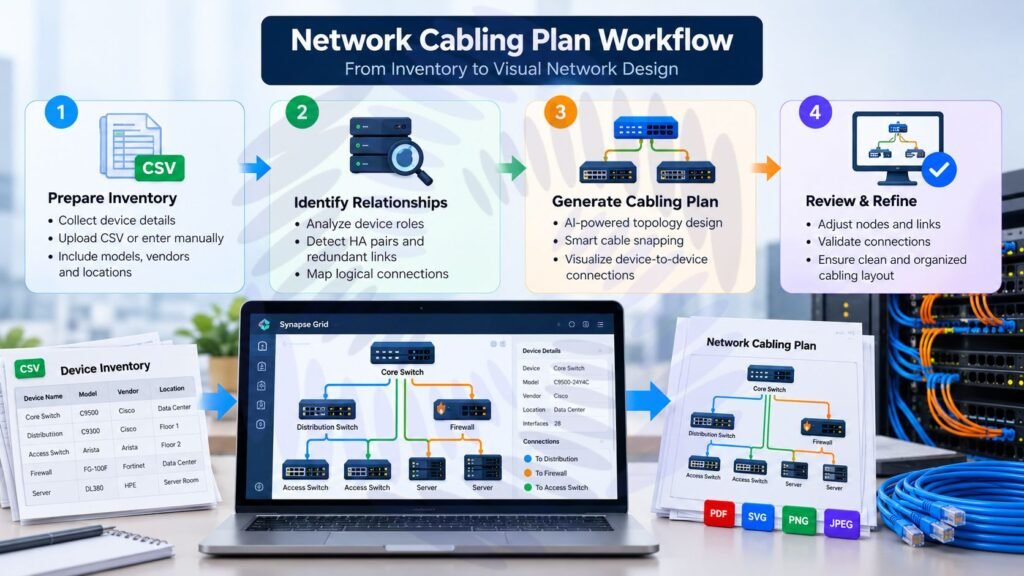
Step 1: Prepare Your Device Inventory
Start by collecting information about the networking equipment included in the project.
The platform supports CSV inventory uploads and manual vendor-count inputs across operational layers.
Useful inventory details may include device models, vendor information, equipment roles, and intended connectivity requirements.
Step 2: Identify Device Relationships
After inventory information is supplied, Synapse Grid uses its correlation capabilities to identify network relationships.
These include high-availability pairs, stacked devices, logical boundaries, and redundancy dependencies.
This stage helps establish which devices have important architectural connections.
Step 3: Generate and Review the Topology
The synthesis engine converts the analyzed information into a structured network diagram.
Engineers can review equipment positioning, inspect connections, and adjust nodes or links through the interactive interface.
The platform recalculates topology layouts as changes are made, helping preserve an organized architecture.
Step 4: Export Network Documentation
Once the topology has been reviewed, teams can export diagrams for technical documentation.
Synapse Grid supports:
- SVG
- PNG
- JPEG
These formats make it easier to share network plans with engineers, project managers, and implementation teams.
Network Cabling Planning Features in Synapse Grid
Different network projects require different levels of connectivity visibility. Synapse Grid combines several capabilities that help engineers prepare and inspect connection-focused architecture.
| Feature | Cabling Planning Benefit |
| Smart Cable Snapping | Keeps logical connections neatly attached to relevant ports |
| Telemetry Overlay | Visually distinguishes connection technologies |
| Logic-Aware Discovery | Identifies important relationships and redundant paths |
| Dynamic Hierarchy | Organizes devices by their architectural roles |
| HA Boundary Logic | Groups high-availability equipment visually |
| Interactive SVG Topology | Supports adjustments to nodes and links |
| Documentation Export | Produces diagrams for technical handoff |
Together, these capabilities provide more contextual information than a basic drawing containing only device icons and connecting lines.
Understanding Different Cable Connections with Telemetry Overlay
A cabling diagram becomes more useful when engineers can distinguish different connection technologies.
Synapse Grid includes a Telemetry Overlay that visually differentiates connection categories such as 100G Fiber, MPLS, Copper, and Management links.
This helps teams interpret the purpose and type of connections without treating every network link identically.
For example, a network architect reviewing a design can distinguish major infrastructure connections from management connectivity.
| Connection Type | Typical Planning Consideration |
| Copper | Ethernet connectivity between compatible devices |
| Fiber | High-capacity or longer-distance connectivity |
| 100G Fiber | High-bandwidth network interconnections |
| MPLS | WAN service connectivity between network locations |
| Management | Connections associated with device administration |
These distinctions can improve communication between engineers reviewing different parts of the network.
However, engineers should separately verify actual cable lengths, physical routes, transceiver compatibility, and installation requirements.
Planning Redundant Cabling Paths for Better Reliability
A network design should consider what happens when an important connection becomes unavailable.
For critical infrastructure, alternative connectivity paths can help maintain services during failures or maintenance.
Synapse Grid’s logic-aware discovery identifies redundancy relationships and high-availability links, making these connections easier to inspect.
Consider an enterprise network with two core switches and multiple distribution switches.
Instead of reviewing a confusing collection of overlapping lines, engineers can use structured topology visualization to examine how distribution equipment connects to available core devices.
This supports decisions about:
- Which devices require redundant connectivity.
- Where important network dependencies exist.
- How high-availability equipment is represented.
- Whether the proposed architecture needs additional review.
Topology visualization does not replace physical route-diversity verification, but it provides a clearer architectural starting point.
Cabling Documentation for Multi-Site Network Projects
Organizations operating several offices or facilities often need consistent network documentation across locations.
Different teams may maintain separate spreadsheets, diagrams, and equipment records, making it difficult to establish an accurate architectural overview.
Synapse Grid supports large-scale topology visualization and includes Global Node Search to help users locate devices across distributed designs.
Its scalable architecture can represent thousands of nodes while maintaining structured network layers.
For multi-site planning, these capabilities can help teams:
- Locate important devices within extensive network diagrams.
- Review interconnections across infrastructure layers.
- Prepare consistent architecture documentation.
- Understand how changes affect related equipment.
- Support technical discussions between distributed engineering teams.
The result is a more manageable approach to reviewing complex network connections.
Network Cabling Plan Software vs. Manual Diagramming
Manual diagramming may be sufficient for smaller networks, but larger projects can require repeated adjustments as equipment and connectivity requirements change.
| Planning Activity | Manual Diagramming | Synapse Grid |
| Device placement | Arranged individually | AI-assisted topology organization |
| Connection drawing | Manually positioned links | Smart logical-port snapping |
| Redundancy review | Requires manual interpretation | Logic-aware relationship mapping |
| Diagram revisions | Manual layout adjustments | Dynamic topology recalculation |
| Large network navigation | Manual visual searching | Global Node Search |
| Documentation | Depends on drawing tool | PDF, SVG, PNG, and JPEG exports |
Synapse Grid is particularly relevant where the primary requirement is network architecture and logical cabling visualization.
Dedicated physical cable-management or CAD solutions may still be necessary for cable-tray routing, floor-plan measurements, and detailed installation schedules.
Best Practices for Preparing Accurate Cabling Plans
Even with intelligent software, successful network planning requires accurate information and engineering review.
Follow these practices when preparing a connection plan:
- Verify the inventory: Confirm device models, interfaces, and equipment quantities.
- Separate connection categories: Clearly distinguish management, uplink, and other network connections.
- Review redundancy: Check that critical equipment has the intended alternative paths.
- Validate physical requirements: Confirm distance limitations, cable specifications, and site constraints.
- Maintain updated documentation: Revise the network design whenever major infrastructure changes occur.
Using software alongside these practices can make cabling plans more dependable throughout the deployment process.
FAQ’s
The best solution depends on project requirements. General diagramming applications are suitable for visual layouts, while specialized tools support physical cable documentation. Synapse Grid focuses on AI-assisted network topology design, logical connectivity, and architectural documentation.
Yes. Synapse Grid converts network specifications and hardware information into structured topology diagrams and cabling plans. Its Smart Cable Snapping feature helps organize logical connections between devices.
Yes. CogniKor identifies support for equipment from Cisco, Fortinet, HPE Aruba, Huawei, and other vendors, making the platform relevant to mixed-vendor network designs.
Clear diagrams can help teams identify connection mistakes before installation. Intelligent connection mapping can also reduce diagramming errors, although actual deployment accuracy still depends on engineering validation and proper installation.
Synapse Grid is designed to support extensive network topologies containing thousands of nodes. Its dynamic hierarchy, search functionality, and interactive diagrams help engineers navigate larger infrastructure designs.
Effective network cabling planning requires more than connecting equipment on a diagram. Engineers must understand device relationships, connection technologies, redundancy requirements, and the documentation needed for successful deployment.
Modern network cabling plan software helps transform these requirements into clearer and more manageable network designs.
Synapse Grid by CogniKor supports this process through intelligent topology generation, Smart Cable Snapping, logical connection mapping, and exportable documentation.
For organizations looking to improve the architectural planning stage of network deployment, Synapse Grid offers an AI-assisted approach to preparing structured network designs.
Ready to simplify your network cabling plans?
Explore Synapse Grid by CogniKor and discover how intelligent topology design can support your next infrastructure project.