

Discover how network dependency mapping with Synapse Grid helps visualize device relationships, HA links, redundancy paths, and structured network topology.
Introduction
Network Dependency Mapping helps IT teams understand how devices, applications, services, and connections depend on each other. Instead of viewing infrastructure as separate components, it creates a clear picture of how the network works as a connected system.
With accurate dependency mapping, teams can identify critical relationships, trace connection paths, spot potential bottlenecks, and understand the impact of infrastructure changes. This makes network monitoring, troubleshooting, migration, and planning more organized and efficient.
What Is Network Dependency Mapping?
Network dependency mapping is the process of showing relationships between network devices, links, paths, and infrastructure components. It creates a visual view of how different parts of the network depend on each other.
A dependency map can help teams understand which devices are connected, which paths support communication, and which components may depend on shared infrastructure. This gives engineers more context than a simple hardware inventory.
Common elements shown in a dependency map can include:
- Routers and switches
- Firewalls
- Core and distribution devices
- Access-layer devices
- WAN connections
- High-availability pairs
- Redundant paths
- Logical network relationships
- Physical and logical links
A clear dependency map makes complex infrastructure easier to understand. Engineers can see relationships visually instead of reading several spreadsheets, configuration files, and old network diagrams.
Why Network Dependency Mapping Matters
Networks rarely remain exactly the same after they are first designed. New devices are added, links are changed, redundancy is introduced, and infrastructure expands across locations.
Because of these changes, old diagrams may no longer represent the actual network structure. Current dependency information can therefore be useful during troubleshooting, network changes, migration planning, maintenance, and infrastructure documentation.
Dependency mapping can help teams answer questions such as:
- Which devices depend on this network component?
- Is there another path if this link fails?
- Which devices form a high-availability pair?
- How is a device connected to the wider topology?
- Where does a device sit within the network hierarchy?
- Which relationships may be affected by a planned change?
The main goal is not simply to create a diagram. The goal is to create useful network context that helps engineers understand infrastructure relationships.
How Synapse Grid Creates Network Context
Synapse Grid is an AI-powered network design and topology platform from CogniKor. It converts hardware information into structured network architecture and visual topology diagrams.
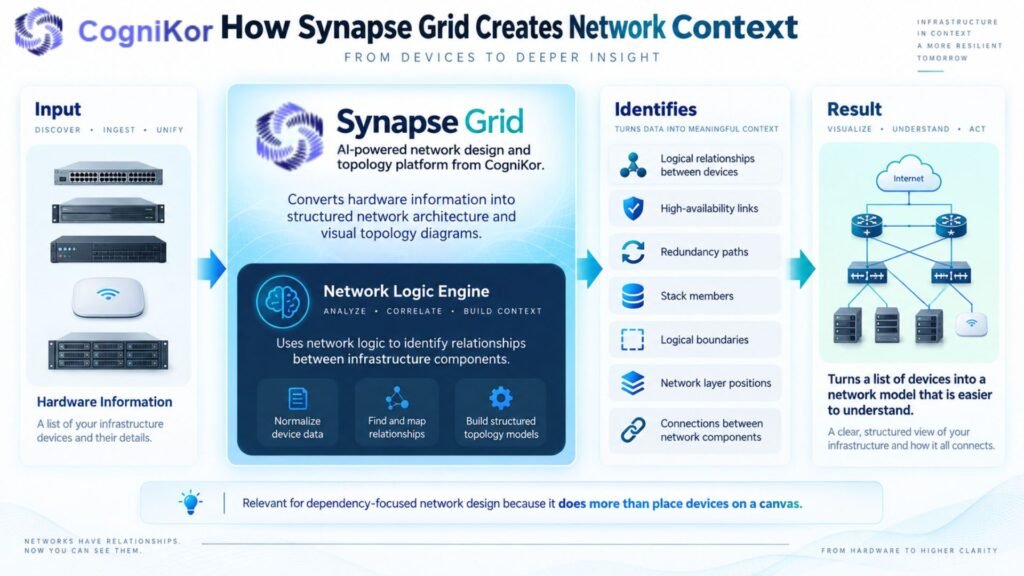
This makes it relevant for dependency-focused network design because the platform does more than place devices on a canvas. It uses network logic to identify relationships between infrastructure components.
Synapse Grid can identify:
- Logical relationships between devices
- High-availability links
- Redundancy paths
- Stack members
- Logical boundaries
- Network layer positions
- Connections between network components
These relationships help turn a list of devices into a network model that is easier to understand.
From Hardware Inventory to Dependency View
A hardware inventory normally tells engineers what equipment exists. It may contain device models, quantities, vendors, and other technical information.
However, an inventory alone does not clearly show how those devices should relate to each other. Synapse Grid adds architectural context by transforming hardware information into an organized network topology.
The platform’s workflow includes inventory, correlation, synthesis, and export.
| Stage | Role in Dependency Mapping |
| Inventory | Provides the network devices and hardware information |
| Correlation | Identifies HA pairs, stack members, and logical boundaries |
| Synthesis | Creates structured topology and connection mapping |
| Export | Produces diagrams for documentation and engineering use |
This process can make network relationships easier to review without manually drawing every connection.
Logic-Aware Relationship Mapping
One of the most important capabilities for dependency mapping is understanding that all connections are not equal.
A device may have a primary connection, a redundant connection, an HA partner, or a specific role within the network architecture.
Synapse Grid uses logic-aware discovery to identify device relationships and automatically map high-availability links, redundancy paths, and logical dependencies.
This can provide engineers with more meaningful information than a basic diagram containing only device icons and lines.
For example, the map can help distinguish between:
- Normal device connections
- HA relationships
- Redundant network paths
- Logical architecture boundaries
- Different infrastructure roles
This additional context makes the network structure easier to interpret.
Clear Network Hierarchy
Large network diagrams can quickly become difficult to read when devices are not organized according to their roles.
Synapse Grid automatically organizes nodes into network layers such as WAN, Edge, Core, Distribution, and Access.
This hierarchy helps engineers understand where a device belongs and how different layers depend on each other.
Instead of seeing a large collection of connected hardware, users can see a structured architecture with clear levels.
This is especially useful when working with enterprise or multi-site network environments where many devices must be shown in one topology.
Mapping High Availability and Redundancy
High availability is an important part of enterprise network architecture. Two devices may work together so that services can continue if one device or path becomes unavailable.
A dependency diagram should make these relationships easy to identify.
Synapse Grid identifies HA pairs and can visually place high-availability clusters inside logical boundaries. It also identifies redundancy paths between network components.
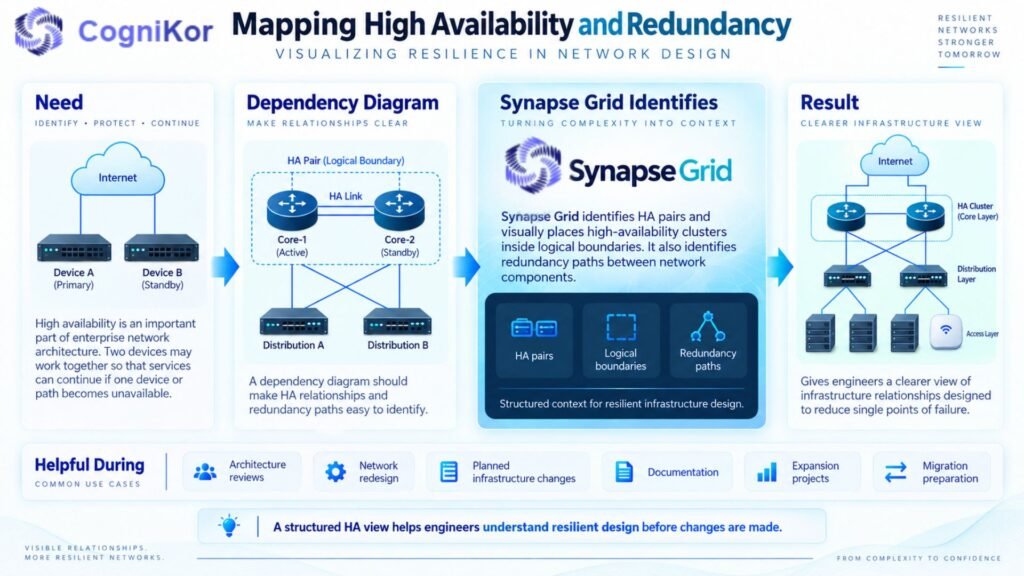
This gives engineers a clearer view of infrastructure relationships that are designed to reduce single points of failure.
A structured HA view can help during:
- Architecture reviews
- Network redesign
- Planned infrastructure changes
- Documentation
- Expansion projects
- Migration preparation
It also reduces the need to manually explain which devices belong together.
Dynamic Changes Without Rebuilding the Diagram
Network architecture changes over time. Devices may be added, removed, repositioned, or connected differently.
Updating large diagrams manually can become time-consuming and may result in inconsistent documentation.
Synapse Grid uses dynamic topology behavior. When a node or connection is changed, the system can recalculate paths while keeping the topology structured.
Its real-time vector ingestion capability also recalculates topology layout as inventory or configuration information changes.
This means teams can work with a more flexible network model instead of constantly rebuilding diagrams manually.
Multi-Vendor Infrastructure in One Map
Enterprise networks often contain hardware from several vendors.
One environment may include Cisco switches, Fortinet security devices, HPE Aruba equipment, Huawei infrastructure, and other platforms.
Synapse Grid supports multiple vendors and uses hardware capabilities to assign device roles, icons, and positions within the network architecture.
This is useful for dependency mapping because the network can be viewed as one connected infrastructure model rather than several separate vendor-specific diagrams.
The result is a more consistent view of network relationships across the environment.
Easier Dependency Review with Search
Finding one device inside a large topology can be difficult.
Synapse Grid includes global node search, allowing users to locate and focus on individual devices across large or distributed topologies.
Once the device is located, engineers can inspect its position and surrounding network relationships more easily.
This can be useful when reviewing:
- Device connections
- Architecture placement
- Nearby infrastructure
- Logical relationships
- Redundancy design
It can also save time when reviewing large multi-site environments.
Better Network Documentation
Dependency mapping becomes more valuable when the information can also be used for documentation.
Synapse Grid can export network architecture in PDF, SVG, PNG, and JPEG formats. Its diagrams are designed to support engineering documentation such as high-level and low-level network designs.
Clear dependency documentation can support:
- Infrastructure reviews
- Network handovers
- Engineering discussions
- Change planning
- Migration projects
- Internal documentation
- Customer documentation
Teams can therefore use the visual topology not only while designing the network but also when communicating its structure.
Synapse Grid for Network Dependency Mapping
Synapse Grid brings device information, network logic, topology generation, hierarchy, HA relationships, and connection mapping into a single workflow.
Instead of manually converting inventory information into diagrams, engineers can use the platform to create structured network architecture with logical context.
| Traditional Process | Synapse Grid Approach |
| Manually place device icons | Automated topology generation |
| Manually identify relationships | Logic-aware relationship identification |
| Draw redundant paths manually | Automatic redundancy mapping |
| Organize devices manually | Dynamic network hierarchy |
| Update diagrams after changes | Dynamic topology recalculation |
| Separate vendor diagrams | Multi-vendor topology support |
| Manual documentation export | Documentation-ready visual outputs |
For organizations working with large or changing network environments, this can reduce repetitive diagramming work while improving visibility into network structure.
FAQ’s
Synapse Grid is designed to support enterprise-scale networks and topologies containing thousands of nodes.
Its search and dynamic hierarchy features can help users navigate larger architectures.
Redundancy paths show alternative network relationships designed to maintain connectivity if another path becomes unavailable.
Seeing these relationships visually can make architecture reviews and change planning easier.
Yes. Network diagrams can be exported as PDF, SVG, PNG, and JPEG files.
These outputs can be used for network architecture and engineering documentation.
Yes. Understanding which devices and paths are related gives engineers more context before changing network infrastructure.
It can help teams review the surrounding architecture and identify connected components before making a change.
No. Inventory and dependency mapping serve different purposes.
Inventory identifies what equipment exists, while dependency mapping explains how network components are logically or physically related.
Conclusion
Network dependency mapping gives network teams a clearer understanding of how infrastructure components relate to each other.
It becomes especially useful when networks include multiple layers, redundant paths, HA pairs, multiple vendors, and large numbers of devices.
Synapse Grid supports this process by turning hardware information into a structured network topology with logical relationships, hierarchy, redundancy, and connection mapping.
For teams that want to move from static hardware lists and manually maintained diagrams to a clearer architecture model, Synapse Grid provides a more automated way to visualize network dependencies.