Learn about Firewall Risk Assessment strategies to identify vulnerabilities and strengthen network security. Evaluate threats and mitigate firewall risks today.
Introduction
Modern network infrastructure faces unprecedented security challenges. Organizations struggle to maintain firewall configurations manually, creating vulnerabilities that expose critical systems to threats.
Firewall risk assessment has become essential for enterprises that want to identify weaknesses before attackers exploit them. CogniKor, a leader in AI-driven security solutions, addresses these challenges through innovative platforms like Cognifire, which transforms how organizations approach firewall risk assessment and management.
Understanding Firewall Risk Assessment in Today’s Threat Landscape
Firewall risk assessment represents a critical component of modern cybersecurity strategy. Security teams conduct thorough evaluations of firewall rules, policies, and configurations to identify gaps, redundancies, and potential vulnerabilities. This process becomes increasingly complex as network environments scale across multiple vendors, cloud platforms, and geographic regions.
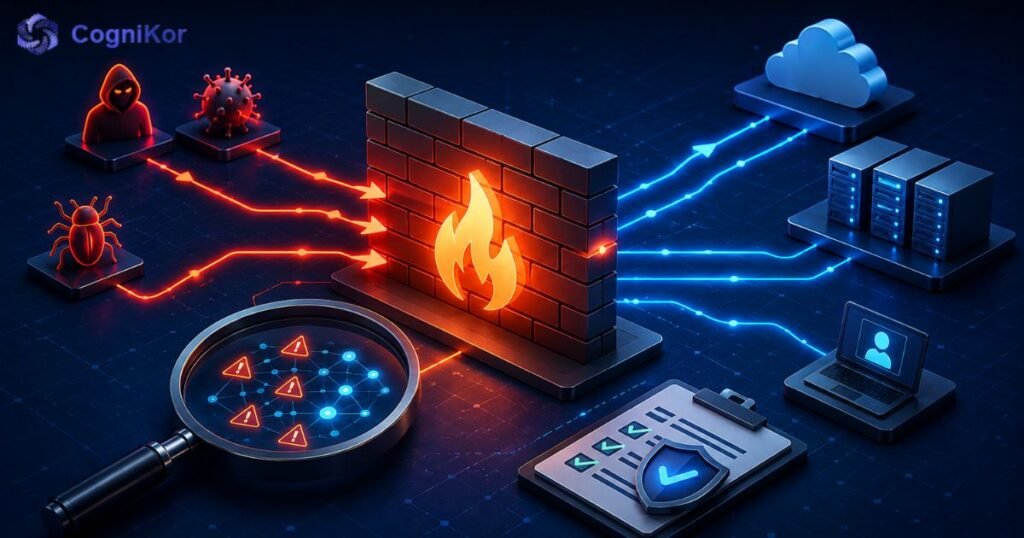
- Traditional manual firewall risk assessment creates significant operational burdens. Security administrators invest hundreds of hours reviewing configuration files, tracking rule dependencies, and validating compliance requirements.
This manual approach introduces human error at every stage; misconfigurations slip through, contradictory rules accumulate, and compliance violations remain undetected. Organizations face difficult choices: invest enormous resources in manual review processes, or accept the risk of unidentified security gaps. - Firewall risk assessment demands a comprehensive understanding of your entire network topology. Administrators must understand how traffic flows through different zones, which rules apply to critical business applications, and whether configurations align with industry standards and regulatory requirements.
Without this visibility, even well-intentioned security policies fail to protect against sophisticated threats. The risk assessment process reveals these blind spots and provides actionable intelligence for improvement. - The consequences of inadequate firewall risk assessment extend beyond technical issues. Organizations face regulatory penalties when assessments fail to demonstrate compliance with standards like PCI-DSS, HIPAA, SOC 2, and ISO 27001.
Breach investigations frequently reveal that proper risk assessment could have prevented the incident. Forward-thinking enterprises recognize that firewall risk assessment is not optionalit represents a fundamental requirement for operational security and business continuity.
How Does Firewall Risk Assessment Identify and Mitigate Threats?
Effective firewall risk assessment employs multiple analytical approaches to identify threats and vulnerabilities. Security teams evaluate rule effectiveness by examining traffic patterns and identifying policies that no longer serve active business functions. These redundant rules accumulate over years of incremental changes, creating confusion and masking critical protections.
Risk assessment processes analyze how different firewall rules interact with each other. Conflicting policies can inadvertently allow dangerous traffic or block legitimate business operations. A comprehensive assessment maps these dependencies and relationships, revealing complex configurations that nobody fully understands. This visibility proves essential for making intelligent configuration changes without introducing new vulnerabilities.
Assessment activities also evaluate firewall configurations against security baselines and best practices. An effective assessment identifies deviations from industry standards and internal policies. It determines whether the organization’s firewall architecture aligns with the principle of least privilege, where rules grant only the minimum necessary access to perform business functions. These baseline comparisons provide measurable metrics for security improvement.
Real-time threat analysis forms another critical component of firewall risk assessment. Modern assessment tools continuously monitor firewall logs and traffic patterns, identifying suspicious activities and emerging threats. Assessment processes detect brute force attempts, unusual protocol usage, and unauthorized network connections. This continuous evaluation enables security teams to respond to threats in real time rather than discovering incidents weeks or months after they occur.
Introducing Cognifire: The AI-Powered Solution for Firewall Risk Assessment
Cognifire represents a revolutionary approach to firewall risk assessment through artificial intelligence and advanced automation. Developed by CogniKor, Cognifire transforms firewall administration from a time-consuming manual process into an intelligent, adaptive security intelligence platform. Cognifire eliminates the traditional bottlenecks that make comprehensive firewall risk assessment impractical for most organizations.
What Makes Cognifire the Industry-Leading Firewall Risk Assessment Platform
Cognifire’s Policy Intelligence Engine underpins its risk assessment capabilities. This engine understands security intent behind firewall rules and converts policies into optimized configurations aligned with industry best practices. Rather than viewing firewall rules as isolated line items, Cognifire recognizes the business logic that drives each configuration decision. This contextual understanding enables Cognifire to identify inconsistencies and risks that simple rule analysis would miss.
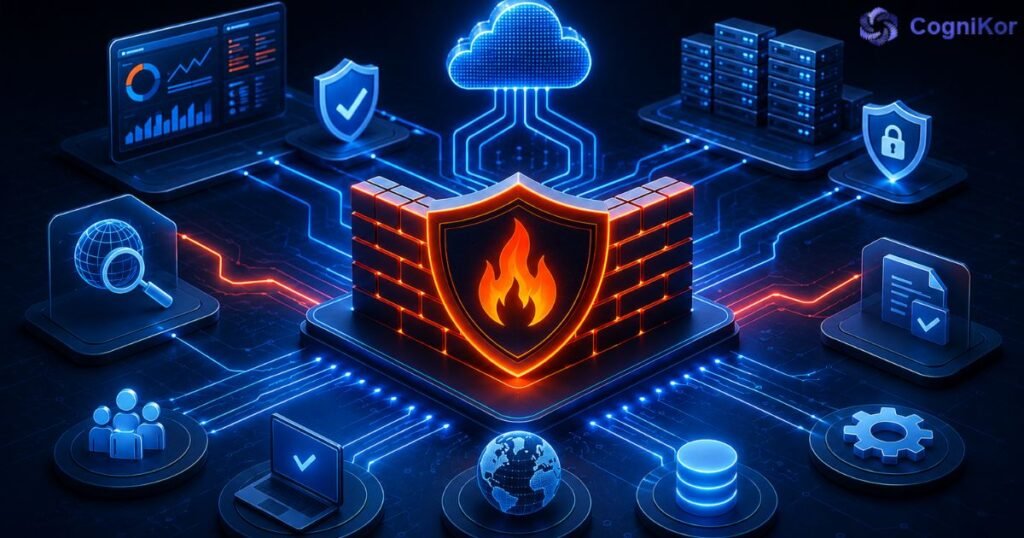
- The Kinetic Rule Optimization feature makes Cognifire truly unique in firewall risk assessment. Cognifire continuously analyzes live traffic behavior against existing firewall rules, identifying redundancies and inefficiencies automatically.
- Organizations gain immediate insights into which rules provide actual protection and which rules exist as legacy artifacts. Cognifire refines firewall policies in real time based on observed network activity, eliminating redundancy while strengthening security posture.
- Cognifire’s multi-vendor firewall intelligence addresses one of the most challenging aspects of firewall risk assessment in heterogeneous environments. Modern enterprises operate firewalls from Palo Alto Networks, Cisco, Fortinet, Check Point, and other vendors simultaneously.
- Cognifire uses advanced retrieval-augmented generation (RAG) technology to understand vendor-specific rule syntax and behavior patterns. This deep multi-vendor knowledge allows Cognifire to accurately assess policies across platforms while recognizing platform-specific configurations and limitations.
Core Capabilities of Cognifire for Comprehensive Risk Assessment
Cognifire delivers powerful capabilities specifically designed for thorough firewall risk assessment:
- Dynamic Policy Hierarchy: Cognifire structures complex rule sets into logical layers that dramatically improve visibility and governance. Security teams immediately understand how different rules relate to each other and which policies take precedence. This structural clarity reveals risks that remain hidden in flat rule lists.
- One-Click Hardening: Cognifire applies security best practices instantly across firewall systems. Organizations implement industry-standard security baselines without manual configuration, ensuring consistent protection across their entire infrastructure.
- Smart Rule Mapping: Cognifire automatically aligns policies to correct network interfaces and security zones. This precise mapping prevents misconfigurations that could leave critical systems exposed to threats.
- Security Baselines: Cognifire provides predefined templates for rapid deployment of secure configurations. These templates incorporate lessons learned from thousands of security deployments and embody proven security practices.
- Real-Time Risk Analysis: Cognifire continuously evaluates vulnerabilities and emerging threats. Organizations receive immediate alerts when Cognifire detects risky configurations or traffic patterns, enabling rapid response.
- Compliance Overlay: Cognifire ensures firewall configurations meet regulatory requirements and internal security policies automatically. This compliance integration eliminates the manual audit work that consumes countless hours in traditional risk assessment.
- Threat Boundary Logic: Cognifire applies logical segmentation to isolate and protect critical network zones. This segmentation approach prevents lateral movement if attackers breach outer network layers.
- Elastic Scaling: Cognifire manages large and complex firewall environments without performance degradation. Organizations with hundreds of firewall instances maintain comprehensive risk assessment coverage.
- Global Policy Search: Cognifire locates rules and configurations instantly across all firewall systems. This capability accelerates incident response and enables rapid validation of security policies.
CogniKor: The Company Powering Advanced Firewall Security
CogniKor specializes in developing AI-driven security and infrastructure solutions for modern enterprises. The company recognizes that traditional security approaches fail to scale with business complexity, and CogniKor creates intelligent automation platforms that elevate security operations beyond manual limitations.
CogniKor’s mission centers on delivering technology that protects infrastructure while reducing operational burden. The company combines deep expertise in cybersecurity, artificial intelligence, and network architecture to create solutions that enterprises actually want to use. Rather than forcing teams to manage complex configuration interfaces, CogniKor builds intuitive platforms that security professionals trust.
The CogniKor portfolio includes multiple specialized products addressing different security challenges. Cognifire focuses on firewall automation and risk assessment, while Firekor handles intelligent firewall migration across platforms. CogniKor’s integrated approach means customers access complementary solutions from a single trusted partner.
Complementary Solutions: Firekor and Integrated Firewall Management
While Cognifire excels at ongoing firewall risk assessment and optimization, Firekor addresses another critical firewall challenge: zero-downtime migration. Firekor uses the same AI capabilities that power Cognifire to translate firewall policies across vendors while preserving security intent.
Organizations planning to migrate from legacy firewall platforms to modern solutions face enormous risk. Misconfigurations during migration can disrupt critical business operations or introduce security gaps. Firekor eliminates this risk through intelligent policy translation and rigorous validation. When organizations combine Cognifire for ongoing risk assessment with Firekor for secure platform transitions, they establish comprehensive firewall management capabilities.
Cognifire and Firekor work synergistically to address the complete firewall management lifecycle. Cognifire identifies optimization opportunities in current environments, while Firekor enables safe transitions to modern infrastructure. Together, these solutions help organizations achieve security excellence across all aspects of firewall administration.
The Business Impact of Intelligent Firewall Risk Assessment
Organizations implementing Cognifire experience transformative improvements across multiple dimensions. Security teams dramatically reduce time spent on manual rule review and configuration validation. This freed-up capacity enables security professionals to focus on strategic initiatives rather than repetitive tactical work.
Cognifire reduces security incidents by identifying and eliminating risky configurations before attackers discover them. The real-time risk analysis continuously monitors firewall behavior, catching emerging threats and misconfigurations that humans would miss. This proactive approach prevents incidents rather than simply responding to breaches.
Compliance teams benefit from Cognifire’s automated compliance overlay functionality. Organizations achieve continuous compliance with regulatory requirements without dedicating staff exclusively to compliance tracking. Audit teams spend less time requesting manual evidence and more time validating security outcomes.
Cost reduction follows naturally from operational improvements. Organizations eliminate redundant hardware purchased to support manual firewall management. Cognifire’s intelligent automation reduces the total cost of ownership for firewall infrastructure while improving security effectiveness.
FAQ’s
You can use your internal IT security team if they have the expertise and resources. Alternatively, hire third-party cybersecurity firms for an unbiased evaluation, compliance auditors to ensure regulatory requirements are met, or a combination of internal teams with external consultants for validation. Managed Security Service Providers can also conduct ongoing assessments.
Assessment professionals use firewall configuration analysis tools, vulnerability scanners, network mapping and discovery tools, log analysis platforms, penetration testing tools, compliance scanning software, and SIEM (Security Information and Event Management) solutions to thoroughly evaluate your firewall security.
Important compliance frameworks include PCI DSS for payment card industry, HIPAA for healthcare, GDPR for data protection, SOC 2 for service organization control, ISO 27001 for information security, NIST Cybersecurity Framework, and CIS Benchmarks from the Center for Internet Security.
A good assessment report includes an executive summary with risk ratings, detailed findings and vulnerabilities, evidence and documentation, business impact analysis, prioritized remediation recommendations, timelines for fixes, cost-benefit analysis, follow-up testing schedule, and compliance status assessment.
Start by prioritizing risks based on severity and business impact. Develop an action plan with clear timelines and responsibilities. Implement fixes following proper change management procedures and test everything thoroughly before deploying to production. Document all changes for audit purposes, train your staff on new policies, monitor the results to ensure effectiveness, and schedule a follow-up assessment to validate that your fixes actually worked.
Conclusion
Firewall risk assessment remains essential for modern cybersecurity, but manual approaches create unacceptable operational burden and security risk. CogniKor’s Cognifire platform eliminates the manual limitations that have constrained firewall risk assessment for years.
By combining policy intelligence, real-time risk analysis, multi-vendor support, and advanced automation, Cognifire enables organizations to achieve comprehensive, continuous firewall risk assessment at scale.
Organizations ready to transform their firewall security should contact CogniKor to discuss how Cognifire delivers the intelligent automation and deep security expertise that modern firewalls demand. The future of firewall risk assessment is intelligent, continuous, and automated, and that future is available now through Cognifire.
Contact CogniKor today to schedule a consultation and discover how Cognifire can revolutionize your firewall risk assessment strategy. Visit www.cognikor.com to learn more about Cognifire, Firekor, and the complete CogniKor portfolio of AI-driven security solutions.