Learn how firewall rule optimization improves network security and performance. Detect conflicts, remove unused rules, and optimize your firewall with Cognifire.
Introduction
In today’s increasingly complex network environments, firewall rule optimization has become more critical than ever for organizations seeking to maintain both security and operational efficiency. As enterprise networks expand across multiple locations, cloud environments, and hybrid infrastructures, firewall configurations can quickly become unwieldy and inefficient. What starts as a well-organized set of security policies often transforms into a bloated collection of redundant, conflicting, and obsolete rules that slow down traffic processing, increase administrative overhead, and create potential security vulnerabilities.
Firewall rule optimization is not simply a maintenance task—it’s a strategic imperative that directly impacts network performance, security posture, and IT operational costs. This comprehensive guide explores why firewall rule optimization matters, the challenges organizations face in managing complex rule sets, and how modern solutions like Cognifire are revolutionizing the way enterprises approach firewall management.
Why Firewall Rule Optimization Matters
Every firewall rule represents a decision point in your network security infrastructure. When traffic traverses your firewall, each packet must be evaluated against your ruleset in sequential order until a match is found. As rule counts grow without proper management, this evaluation process becomes increasingly time-consuming, resulting in higher latency and reduced throughput.
Beyond performance considerations, poorly optimized firewall rules create significant operational and security challenges. Rules that haven’t been reviewed in months or years may reference deprecated systems, obsolete applications, or long-decommissioned users. Rules may overlap in confusing ways, with administrators unsure whether certain security policies are actually being enforced. This lack of clarity transforms your firewall from a protective barrier into a potential liability.
Organizations typically find that after several years of incremental rule additions and modifications, their firewall configurations have grown to contain 30-40% redundant or unused rules. This bloat directly correlates with increased security incidents, failed compliance audits, and frustrated IT teams struggling to understand their own security policies.
The Hidden Costs of Unoptimized Firewalls
Unoptimized firewall configurations generate costs across multiple dimensions:
- Performance Degradation: Each additional rule increases packet processing time. For organizations processing millions of transactions daily, this latency compounds into significant user experience impacts.
- Security Gaps: Conflicting or unclear rules often result in overly permissive policies, as administrators adopt an “allow unless explicitly denied” approach rather than risk breaking business-critical applications.
- Compliance Failures: Auditors expect firewall rules to directly reflect documented security policies. Bloated, poorly documented rule sets consistently fail compliance reviews.
- Administrative Burden: IT teams spend excessive hours troubleshooting connectivity issues, tracking rule lineage, and attempting to document rules whose original purpose has been lost to time.
- Increased Attack Surface: Unused rules and conflicting policies create opportunities for skilled attackers to find gaps in your security posture.
Understanding Firewall Rule Optimization
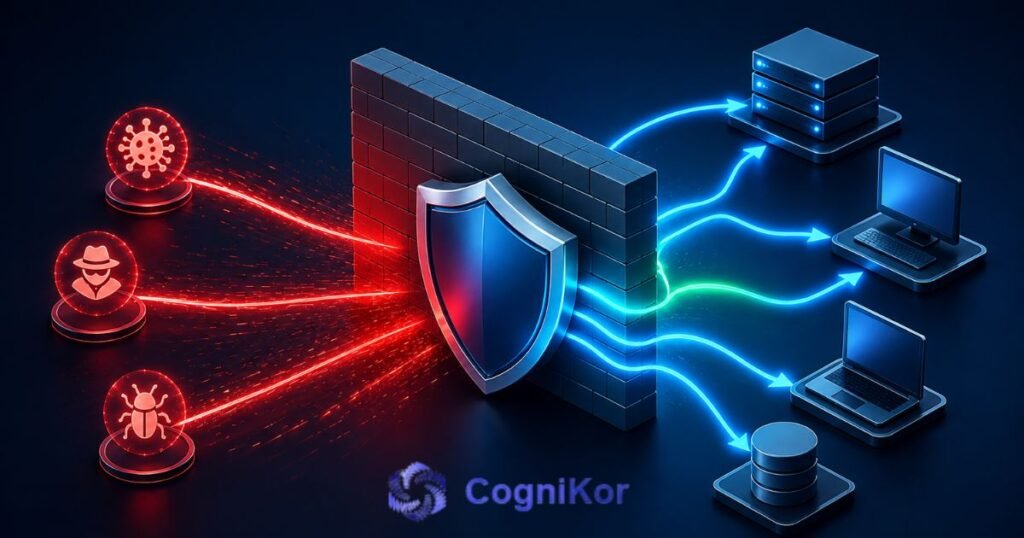
Firewall rule optimization is a multifaceted process that involves analyzing, refining, and reorganizing firewall configurations to maximize both security effectiveness and network performance. True optimization goes beyond simply deleting old rules—it requires understanding the relationship between rules, identifying opportunities for consolidation, and ensuring that security policies align with current business requirements.
Effective firewall rule optimization incorporates several key principles:
- Rule Consolidation: Identifying rules with overlapping conditions and consolidating them into more efficient rules that achieve the same security outcome.
- Rule Ordering: Arranging rules so that the most commonly matched rules appear first, reducing average packet evaluation time.
- Policy Alignment: Ensuring that firewall rules accurately reflect documented security policies and business requirements.
- Documentation: Creating clear, maintainable documentation that explains the purpose and dependencies of each rule.
- Continuous Review: Establishing processes for regular rule review and archival of unused policies.
Firewall Rule Conflict Detection: Identifying Hidden Problems
One of the most overlooked aspects of firewall management is firewall rule conflict detection. Conflicts occur when multiple rules could potentially match the same traffic, creating ambiguity about which policy will actually be enforced.
Consider a scenario where Rule A permits traffic from Department A to Server X, while Rule B explicitly denies traffic from Department A to Server X. If Rule A appears first in your ruleset, traffic will be permitted, and Rule B becomes redundant. If administrators later remove Rule B, believing it unnecessary, they may inadvertently weaken their security posture if they misunderstood the original intent.
Common types of firewall rule conflicts include:
- Contradictory Rules: Rules that permit and deny the same traffic based on different conditions.
- Redundant Rules: Rules that accomplish the same security objective but use different, overlapping conditions.
- Shadowed Rules: Rules that will never be evaluated because earlier rules match their traffic first.
- Partially Overlapping Rules: Rules whose conditions overlap partially, creating uncertainty about behavior for specific traffic patterns.
Firewall rule conflict detection typically requires manual analysis of your entire ruleset, comparing conditions, destinations, sources, and actions across hundreds or thousands of rules. This process is time-consuming, error-prone, and requires deep expertise in both your network architecture and firewall platform specifics.
Unused Firewall Rule Removal: Cleaning Your Security Infrastructure
Parallel to conflict detection, unused firewall rule removal represents another critical component of firewall optimization. Many organizations operate with rule retention policies dictated more by fear than by data—administrators hesitate to delete rules because they cannot definitively prove that no traffic matches those rules anymore.
Unused rules accumulate for predictable reasons:
- Applications are replaced, but their associated firewall rules remain
- Security policies change, leaving old rules in place “just in case”
- Mergers and acquisitions introduce rules from multiple firewall platforms with overlapping coverage
- Administrative turnover means knowledge of rule purpose disappears before the rule itself
The challenge with unused firewall rule removal is certainty. Deleting a rule based on incorrect assumptions can break business-critical applications and damage your organization’s credibility with business units. Modern unused firewall rule removal requires traffic analysis and behavioral understanding—confirming that no traffic has matched a specific rule over an extended observation period before recommending removal.
How Cognifire Transforms Firewall Rule Optimization
CogniFire, powered by the CogniKor AI Engine, represents a significant leap forward in addressing the complexity of firewall rule optimization. Rather than treating firewall management as a static configuration task, CogniFire applies artificial intelligence and machine learning to transform firewall administration into a dynamic, continuously optimizing process.
- Kinetic Rule Optimization: CogniFire’s core engine continuously analyzes traffic patterns against your ruleset, identifying optimization opportunities in real time. The system dynamically reorganizes rules based on actual traffic behavior, ensuring that your most-used rules are evaluated first, reducing average latency and improving overall network performance.
- Intelligent Conflict Resolution: CogniFire’s firewall rule conflict detection capabilities analyze your entire ruleset, identifying contradictory rules, shadowed rules, and redundant policies. The system presents conflicts in a clear visual format, allowing administrators to understand the impact of each conflicting rule and make informed decisions about consolidation and removal.
- Automated Unused Rule Identification: Rather than forcing administrators to guess at rule usage, CogniFire monitors actual traffic over an extended period, identifying with high confidence which rules receive no traffic. The system differentiates between rules that can safely be removed and rules that address edge cases or security requirements that don’t generate regular traffic.
- Multi-Vendor Support: CogniFire’s multi-vendor firewall intelligence supports heterogeneous environments, mapping and optimizing policies across different firewall platforms simultaneously. Organizations no longer need separate tools for each firewall vendor—CogniFire provides unified visibility and optimization.
- Policy Intelligence Engine: Beyond optimization, CogniFire’s Policy Intelligence Engine understands security intent and automatically converts policies into optimized configurations aligned with industry best practices.
The Business Impact of Optimized Firewalls
Organizations implementing comprehensive firewall rule optimization through CogniFire consistently report significant benefits:
- Performance Improvements: Optimized rule ordering reduces average packet evaluation time by 30-60%, translating into reduced latency for users and applications.
- Reduced Security Incidents: Clear, conflict-free rules reduce the likelihood of unintended policy gaps. Compliance auditors consistently find optimized rule sets easier to validate against security policies.
- Administrative Efficiency: Reducing rule count by 30-40% and automating conflict detection frees IT teams to focus on strategic security initiatives rather than rule management.
- Cost Reduction: Fewer rules mean reduced firewall processing load, potentially extending firewall hardware lifecycle and reducing power consumption in data centers.
- Improved Compliance: Clear documentation and automated conflict detection simplify compliance audits and security reviews.
Implementation Best Practices
Successful firewall rule optimization requires more than just deploying a tool:
- Establish Baseline Metrics: Before optimization, document current rule count, average packet evaluation time, and rule age distribution.
- Enable Traffic Monitoring: Deploy comprehensive traffic analysis to identify unused rules and understand current traffic patterns.
- Phase Optimization Gradually: Rather than optimizing your entire ruleset at once, tackle optimization in phases by security zone or business unit.
- Maintain Change Documentation: Document every rule modification, creating an audit trail that supports compliance requirements.
- Schedule Regular Reviews: Establish quarterly or semi-annual firewall rule reviews to prevent future bloat.
FAQ’s
Rules should be ordered from most specific to least specific, and from most frequently used to least used for performance. Place deny rules before broader allow rules. Group related rules together (e.g., all HTTP/HTTPS rules). Put critical security rules at the top. This order prevents rule conflicts and ensures proper traffic handling.
Consolidation involves combining rules with similar actions and conditions. For example, if you have separate rules allowing traffic from IPs 192.168.1.1, 192.168.1.2, and 192.168.1.3, replace them with a single rule for 192.168.1.0/24. Use object grouping features in your firewall to reference multiple objects in one rule. Document the consolidation for audit purposes.
Firewall management platforms, SIEM systems, network traffic analyzers, and specialized firewall optimization tools can provide rule usage analytics. Many enterprise firewalls (Palo Alto Networks, Cisco ASA, Fortinet) have built-in optimization features. Cloud providers offer rule analysis through their security dashboards.
Optimized rules reduce CPU utilization during packet inspection, lower latency for legitimate traffic, improve throughput, and decrease memory consumption. However, the impact depends on your traffic volume and current rule complexity. Organizations often see 10-30% performance improvements, though results vary.
Common errors include removing rules without understanding their purpose (causing service outages), creating overly broad allow rules for convenience, failing to document changes, not testing optimization in a staging environment, ignoring rule dependencies, optimizing without considering business requirements, and neglecting to maintain an audit trail of changes.
Conclusion
Firewall rule optimization has evolved from a nice-to-have maintenance task into a strategic necessity for modern organizations. The complexity of contemporary network environments, combined with the security and compliance demands of regulatory frameworks, makes continuous firewall rule optimization essential.
Whether your organization is struggling with firewall rule conflict detection, attempting to identify unused firewall rules for removal, or simply seeking to maximize firewall performance, solutions like Cognifire provide the intelligent automation and AI-driven insights necessary to overcome these challenges.
By combining sophisticated analysis capabilities with user-friendly visualization and actionable recommendations, Cognifire enables organizations to transform their firewall from a static configuration into a dynamic, continuously optimizing security infrastructure. In an era where network security directly impacts business continuity, investing in comprehensive firewall rule optimization through intelligent platforms is not optional—it’s essential.
The future of firewall management belongs to organizations that embrace intelligent, automated approaches to firewall rule optimization. Contact CogniFire today to learn how you can optimize your firewall infrastructure and strengthen your organization’s security posture.