

Simplify enterprise network design with Synapse Grid, an AI-powered network planning software for automated topology mapping, cabling, and documentation.
Introduction
Planning an enterprise network involves more than connecting switches, routers, and firewalls. Engineers must understand hardware requirements, establish logical connections, organise network layers, and prepare accurate documentation before infrastructure can be implemented.
When network environments expand across multiple locations and hardware vendors, traditional planning methods become increasingly difficult to maintain. Outdated diagrams, unclear device relationships, and repetitive manual design work can introduce errors that delay deployment.
Network planning software helps organisations structure their infrastructure designs, visualise connections, and prepare for network changes more effectively.
For businesses that need automated network architecture design, Synapse Grid by
CogniKor offers an AI-powered approach that converts hardware information into structured network topologies, maps logical relationships, and produces documentation-ready diagrams.
What Is Network Planning Software?
Network planning software is a category of tools that helps IT professionals design, organise, visualise, and evaluate network infrastructure before deployment or modification.
These tools help engineers determine how networking components should connect, where devices belong within an architecture, and how infrastructure can support operational requirements.
Depending on the software, capabilities may include topology diagramming, device inventory management, connectivity modelling, capacity analysis, network simulation, and technical documentation.
For example, an enterprise planning a new office network may need to identify the appropriate distribution and access layers, determine switch connections, plan redundant paths, and document the proposed layout before installation begins.
Rather than managing this information through unrelated spreadsheets and manually drawn diagrams, suitable network planning tools bring important design information into a more organised workflow.
Key Functions of Network Planning Software
| Function | Purpose |
| Network topology design | Represent devices and connections in a structured architecture |
| Device inventory organisation | Maintain information about networking hardware |
| Connection mapping | Show physical or logical relationships between devices |
| Capacity planning | Assess bandwidth and resource requirements where supported |
| Redundancy planning | Identify alternate paths and high-availability requirements |
| Network documentation | Prepare technical diagrams for deployment and maintenance |
| Change planning | Evaluate proposed modifications to network architecture |
Not every network planning platform offers all these functions. Some focus on traffic analysis and capacity forecasting, while others specialise in topology generation, architectural modelling, or network documentation.
Selecting the right software therefore depends on whether an organisation needs to monitor network performance, simulate behaviour, develop architecture, or automate the network design process.
Common Challenges in Network Planning and Design
Enterprise network planning becomes more demanding as infrastructure grows. A small environment may require only a few switches and connections, while a distributed organisation may operate hundreds or thousands of devices across multiple sites.
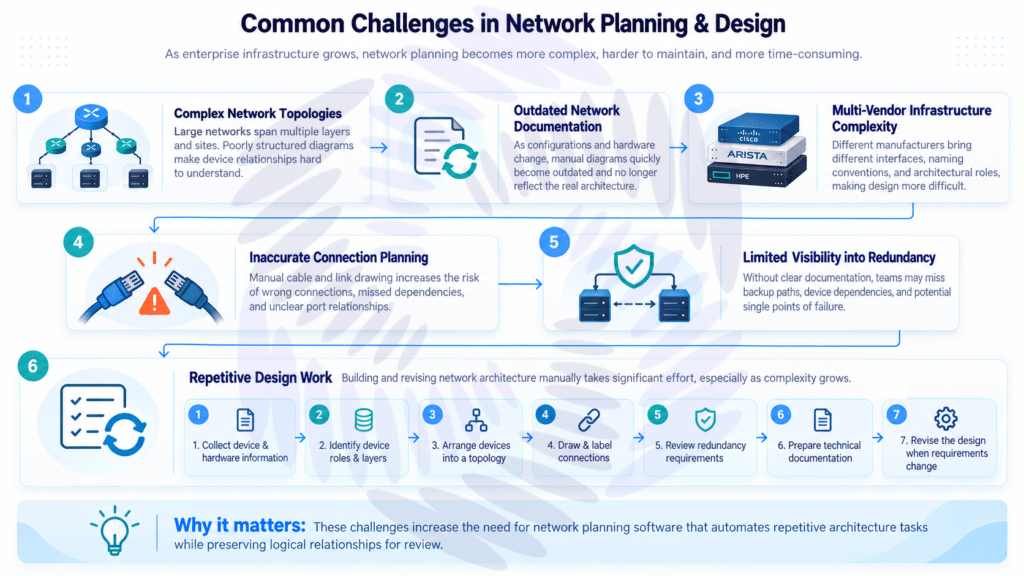
Without a consistent planning approach, network engineers can face several problems that affect design accuracy and implementation efficiency.
1. Complex Network Topologies
Large networks contain interconnected components across different architectural layers. Identifying how these components relate to one another can be difficult when network diagrams are poorly structured.
A crowded topology can obscure important connections and make infrastructure reviews unnecessarily complicated.
2. Outdated Network Documentation
Network configurations and hardware inventories change over time. New switches are installed, redundant connections are introduced, and existing devices are replaced.
When diagrams are updated manually, documentation may no longer reflect the intended or deployed network architecture.
3. Multi-Vendor Infrastructure Complexity
Many organisations operate equipment from different manufacturers. Device capabilities, interfaces, naming conventions, and architectural roles can vary between platforms.
Engineers must account for these differences when creating network designs and defining connections.
4. Inaccurate Connection Planning
Manually drawing cables and logical links increases the possibility of incorrect connections, missing dependencies, and unclear port relationships.
These problems may remain unnoticed until engineers review the design or begin implementation.
5. Limited Visibility into Redundancy
High-availability designs require careful consideration of primary connections, backup paths, and device dependencies.
If those relationships are not documented clearly, teams may struggle to understand whether the proposed architecture contains unnecessary dependencies or potential single points of failure.
6. Repetitive Design Work
Preparing a complete network architecture often involves several manual tasks:
- Collecting device and hardware information.
- Identifying device roles and network layers.
- Arranging devices into a topology.
- Drawing and labelling connections.
- Reviewing redundancy requirements.
- Preparing diagrams for technical documentation.
- Revising the design when requirements change.
The effort required for these activities increases with infrastructure size and complexity.
This creates a need for planning software that can automate repetitive architectural tasks while preserving the logical relationships engineers need to review.
How Synapse Grid Simplifies Network Planning with AI
Traditional network planning often depends on engineers manually translating device information into diagrams. This may work for smaller environments, but enterprise architecture requires a more structured approach.
CogniKor developed Synapse Grid to help network teams move from scattered hardware information to organised, interactive network architecture.
Synapse Grid is an AI-powered network design and topology platform that analyses infrastructure inputs, identifies device relationships, and generates structured network diagrams.
Instead of requiring engineers to build every connection manually, the platform uses hardware-aware logic to support topology creation, network layer organisation, and cabling plans.
Its architecture-focused capabilities include:
- AI-assisted topology generation: Create structured network diagrams from hardware and infrastructure information.
- Logic-aware relationship mapping: Identify high-availability pairs, redundancy paths, and logical dependencies.
- Multi-vendor support: Work with network hardware from Cisco, Fortinet, HPE Aruba, Huawei, and other supported vendors.
- Dynamic topology interaction: Modify nodes and links while the diagram layout recalculates.
- Documentation exports: Generate diagrams for network architecture documentation.
By bringing these tasks together, Synapse Grid helps engineers spend less time arranging network diagrams and more time reviewing infrastructure design decisions.
Key Features of Synapse Grid for Enterprise Network Planning
Synapse Grid combines several architecture-focused capabilities to address different stages of the network planning process.
1. Automated Network Topology Generation
Creating a topology manually requires engineers to place devices, assign roles, draw connections, and organise the overall layout.
Synapse Grid helps automate this process by converting network inventory and device information into a structured visual design.
The platform supports:
- Automated device positioning.
- Intelligent connection mapping.
- Logical network hierarchy.
- Structured topology visualisation.
- Design updates when relevant infrastructure information changes.
This is particularly useful when preparing architecture designs for new deployments or documenting large existing environments.
2. Logic-Aware Device Relationship Mapping
Understanding individual devices is only one part of network planning. Engineers also need to know how devices depend on each other.
Synapse Grid’s logic-aware discovery identifies important architectural relationships, including high-availability links, redundant paths, and logical dependencies.
These relationships provide additional context when reviewing network architecture and planning modifications.
3. Dynamic Network Layer Organisation
Enterprise networks commonly use multiple architectural layers to separate responsibilities and organise connectivity.
Synapse Grid automatically positions devices within layers such as:
- WAN
- Edge
- Core
- Distribution
- Access
This hierarchy makes it easier to understand where devices belong and how different infrastructure components interact.
4. Intelligent Cabling and Connection Mapping
Network diagrams can become confusing when links overlap, connect to inappropriate locations, or lack clear identification.
Synapse Grid uses smart cable snapping to align connections with relevant logical ports.
The platform also visually distinguishes link types, including:
- 100G fibre links.
- MPLS connections.
- Copper connections.
- Management links.
This gives network engineers a clearer view of connectivity while preparing cabling plans and reviewing architecture.
5. Interactive Topology Updates
Network design rarely remains unchanged throughout a project.
Engineers may need to add switches, adjust links, modify topology structure, or reorganise device relationships.
Synapse Grid uses interactive SVG topology diagrams that recalculate layout and paths as nodes or connections are modified.
This helps reduce repeated manual rearrangement and keeps diagrams structured during design revisions.
6. Scalable Network Architecture
Large enterprise networks require tools that can represent extensive infrastructure without making diagrams difficult to navigate.
Synapse Grid is designed to support topologies containing thousands of nodes.
Its global node search also allows users to find individual devices within large or distributed architectures.
These capabilities help teams navigate complex network environments while maintaining architectural visibility.
How to Plan a Network Using Synapse Grid?
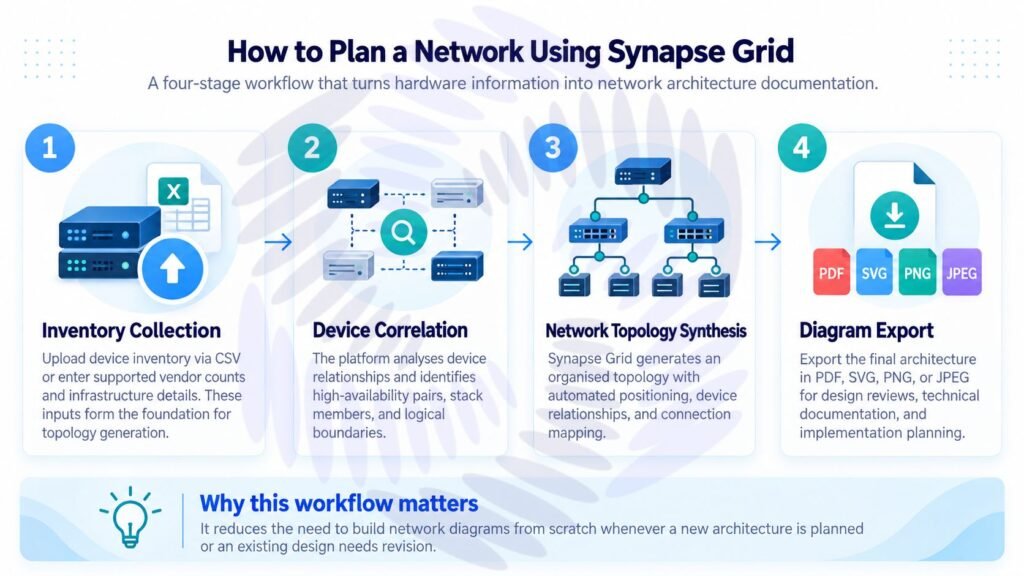
Synapse Grid follows a four-stage workflow that converts hardware information into network architecture documentation.
- Inventory Collection
Upload device inventory information through CSV or enter supported vendor counts and infrastructure details. These inputs provide the foundation for topology generation. - Device Correlation
The platform analyses relationships between devices and identifies high-availability pairs, stack members, and logical boundaries. - Network Topology Synthesis
Synapse Grid generates an organised topology with automated positioning, device relationships, and connection mapping. - Diagram Export
Export the resulting architecture in PDF, SVG, PNG, or JPEG format for design reviews, technical documentation, and implementation planning.
This workflow reduces the need to build network diagrams from scratch every time a new architecture is planned or an existing design needs revision.
Manual Network Planning vs Synapse Grid
Manual planning and AI-assisted topology generation can serve similar architectural goals, but the amount of repetitive design work can differ significantly.
| Planning activity | Manual approach | Synapse Grid |
| Device placement | Individual device positioning | Automated layout generation |
| Topology creation | Manually drawn diagrams | AI-assisted topology synthesis |
| Device relationships | Engineer identifies and documents links | Logic-aware relationship identification |
| Network layers | Manually organised | Automatic hierarchy organisation |
| Cabling diagrams | Connections drawn individually | Smart cable snapping and link mapping |
| Architecture revisions | Repeated manual diagram editing | Interactive recalculation |
| Large-scale navigation | Manual navigation and diagram organisation | Global node search |
| Documentation | Manually prepared or exported | PDF, SVG, PNG and JPEG exports |
CogniKor states that Synapse Grid can generate network designs in under two minutes, compared with a stated manual baseline of three to ten days, and reports a near-zero cabling error rate. These are vendor-reported figures rather than independently verified performance guarantees; actual results will depend on project scope and input quality.
Where Synapse Grid Fits into Enterprise Network Planning
Different organisations have different infrastructure planning requirements. Synapse Grid’s architecture automation features are especially relevant to projects that require clear topology designs and structured connectivity documentation.
Data Centre Network Architecture
Data centre networks require organised switching architectures, multiple device relationships, and carefully planned redundant paths.
Synapse Grid supports project baselines such as data centre spine-leaf architecture, helping engineers establish a structured starting point for more complex designs.
Multi-Site Enterprise Infrastructure
Organisations operating across offices, branches, or distributed facilities may need to document large numbers of network devices.
Synapse Grid’s hierarchical organisation and global node search help engineers locate devices and understand network relationships across extensive topologies.
Network Infrastructure Upgrades
Before replacing or introducing network equipment, engineers need to understand the existing design and how proposed changes affect the architecture.
With interactive node and link modifications, Synapse Grid supports the creation and revision of topology diagrams during infrastructure upgrade planning.
High-Availability Architecture Planning
Networks that depend on redundant components need clear visibility into how their high-availability connections are structured.
Synapse Grid identifies HA relationships and represents related devices within logical boundaries, making redundancy arrangements easier to review.
Why Choose CogniKor for Network Planning?
CogniKor focuses on AI-driven infrastructure solutions that reduce manual technical workloads and improve visibility into complex enterprise environments.
Synapse Grid brings this approach specifically to network architecture design.
Its value lies in combining hardware information, device relationship analysis, interactive topology generation, and technical diagram exports within a single planning workflow.
For network engineering teams, this creates several practical benefits:
- Less repetitive diagram construction.
- Clearer architectural relationships between devices.
- More consistent network layer organisation.
- Improved visibility into high-availability layouts.
- Easier preparation of network design documentation.
- Better navigation across large infrastructure diagrams.
Synapse Grid is particularly relevant for organisations prioritising topology design automation and architecture documentation. Teams that primarily require live bandwidth forecasting, traffic simulation, or IP address management should evaluate those needs separately, since they are not established as core Synapse Grid features on its published product page.
FAQ’s Network Planning Software
Network planning software helps engineers organise network infrastructure, design connectivity, visualise device relationships, and prepare documentation before implementing or modifying a network.
Yes. Synapse Grid uses AI-assisted topology generation to convert supported hardware and inventory information into structured network architecture diagrams.
Yes. CogniKor lists support for vendors including Cisco, Fortinet, HPE Aruba, and Huawei. Synapse Grid also uses device fingerprinting to help determine appropriate roles and layer positioning.
Yes. The platform supports cabling plan creation, intelligent link mapping, and smart cable snapping to relevant logical ports.
Synapse Grid is designed for enterprise-scale topologies containing thousands of nodes. Its hierarchical architecture and device search functionality help users navigate extensive designs.
Conclusion
Effective network planning requires accurate device information, clear architecture, and a structured approach to connectivity.
As enterprise infrastructure expands, manually organising hardware relationships and maintaining topology diagrams can consume valuable engineering resources.
Synapse Grid by CogniKor helps simplify these tasks through AI-powered topology generation, intelligent relationship mapping, dynamic network design, and documentation-ready exports.
Whether your team is designing a new enterprise architecture, planning a data centre topology, or updating existing network documentation, Synapse Grid provides an automated approach to organising complex infrastructure.
Explore Synapse Grid and discover how AI-assisted network planning software can make your next infrastructure design project more efficient.
Start Designing Smarter with CogniKor.