Design resilient networks with High Availability Network Design. Use Synapse Grid to map network dependencies, improve redundancy, and maintain reliable connectivity.
Introduction
High Availability Network Design helps organizations build network infrastructure that remains reliable even when devices, links, or connections fail. It focuses on redundancy, resilient architecture, and reducing single points of failure.
With modern networks becoming more complex, manually planning redundant connections can be difficult. Synapse Grid helps visualize network relationships and dependencies, making it easier to understand how devices connect and where availability risks may exist.
By turning infrastructure data into a clear network topology, teams can identify critical dependencies, review redundant paths, and create a more resilient network design.
How High Availability Network Design Improves Network Resilience?
A high availability network is designed to continue providing connectivity when components or paths fail. Instead of relying on a single device or connection, architects introduce redundancy at different layers of the infrastructure.
The challenge is not simply adding more equipment. Redundancy needs to be logically represented, correctly connected, documented, and sized so that the alternative path can support the required traffic when a failure occurs.
Common challenges include:
- Single points of failure: One critical switch, router, link, or component can interrupt dependent services.
- Complex redundancy relationships: HA pairs, stacks, dual links, and dependencies become harder to track manually.
- Inconsistent network documentation: Diagrams can become outdated as inventory and configurations change.
- Manual topology errors: Hand-drawn connections and large diagrams can introduce incorrect or confusing relationships.
The impact can extend beyond an outage itself. Poor visibility into redundancy can make troubleshooting, capacity planning, maintenance, and network changes more difficult, especially in large multi-site environments.
What Is the Modern Approach to High Availability Network Design?
Modern high availability network design combines architectural redundancy with accurate topology visibility. Instead of treating a network diagram as a static drawing, teams can use structured infrastructure data to understand device relationships, HA boundaries, connection types, and logical dependencies.
Synapse Grid is designed around this approach. Its AI-powered engine converts hardware data into structured network architecture and identifies relationships such as HA links, redundancy paths, and logical dependencies.
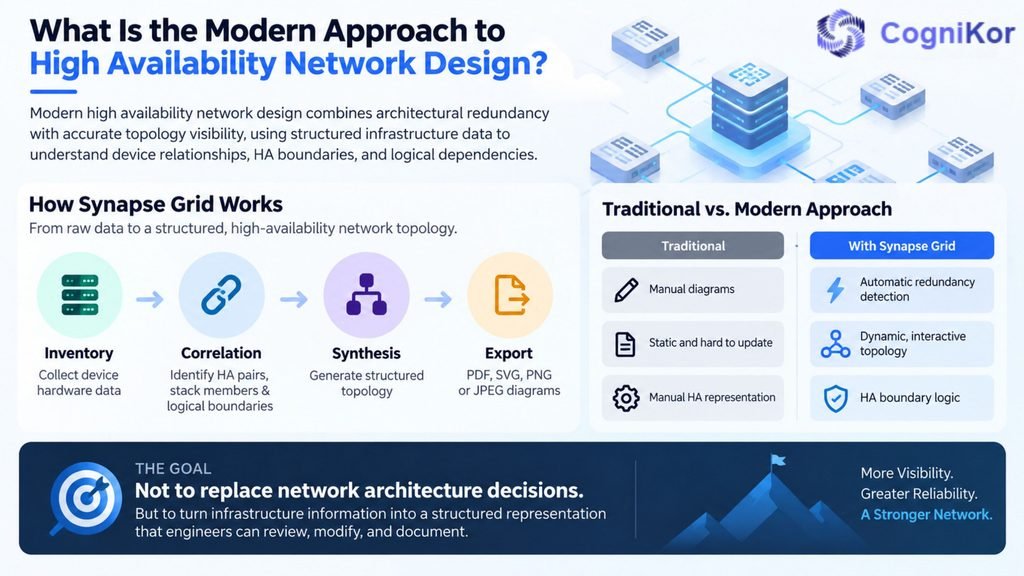
The basic workflow is:
Inventory → Correlation → Synthesis → Export
During correlation, Synapse Grid identifies HA pairs, stack members, and logical boundaries before generating the structured topology.
| Traditional Approach | Modern Approach with Synapse Grid |
| Manually draw redundant connections | Automatically identify redundancy relationships |
| Static network diagrams | Dynamic, interactive topology |
| Manually organize network layers | Automatic WAN, Edge, Core, Distribution, and Access hierarchy |
| Manually represent HA clusters | HA Boundary Logic |
| Rework diagrams after changes | Real-time topology recalculation |
| Manually prepare documentation | Export PDF, SVG, PNG, and JPEG diagrams |
| Vendor-specific visual organization | Multi-vendor device fingerprinting |
The goal is not to replace network architecture decisions. Instead, Synapse Grid helps turn infrastructure information into a more structured representation that engineers can review, modify, and document.
How Synapse Grid Supports High Availability Network Design
Synapse Grid has several capabilities that directly relate to high availability network design. Its Logic-Aware Discovery identifies relationships between devices and automatically maps high-availability links, redundancy paths, and logical dependencies.
1. Logic-Aware Discovery
Synapse Grid analyzes relationships between network devices rather than simply placing equipment on a diagram. This helps identify HA links, redundancy paths, and logical dependencies within the architecture.
2. HA Boundary Logic
High-availability clusters can be visually represented using dedicated logical boundaries. This makes redundant groups easier to identify when reviewing large enterprise topologies.
3. Real-Time Topology Recalculation
The platform uses dynamic topology interaction so that changes to nodes or links can trigger path recalculation. This helps maintain a structured diagram while the design evolves.
4. Multi-Vendor Fingerprinting
Synapse Grid automatically assigns device roles, icons, and layer positioning based on hardware capabilities. The product page states that it supports environments involving vendors including Cisco, Fortinet, HPE Aruba, and Huawei.
A Practical Example
Consider an enterprise environment containing redundant core switches, distribution devices, firewalls, access switches, and multiple uplinks. Instead of manually creating every relationship, the team can provide inventory information to Synapse Grid, allow the system to correlate HA pairs and logical dependencies, and then generate a structured topology for engineering review.
This creates a clearer representation of the intended resilient architecture before the design moves into implementation and documentation.
Synapse Grid vs Traditional High Availability Network Design Tools
High availability design can involve diagramming software, spreadsheets, network documentation platforms, and manual engineering processes. Synapse Grid takes a more specialized approach by connecting infrastructure inventory with AI-assisted topology synthesis.
| Capability | Traditional Manual Workflow | Synapse Grid |
| Hardware inventory | Spreadsheet/manual collection | CSV or structured inventory input |
| HA relationship mapping | Manual | Logic-aware discovery |
| HA cluster visualization | Manual diagramming | HA Boundary Logic |
| Network hierarchy | Manual placement | Dynamic hierarchy |
| Multi-vendor identification | Manual | Multi-vendor fingerprinting |
| Topology changes | Manual diagram updates | Real-time recalculation |
| Cable layout | Manual drawing | Smart Cable Snapping |
| Large topologies | Increasingly difficult to maintain manually | Designed to support thousands of nodes |
| Documentation | Manual export/preparation | PDF, SVG, PNG, JPEG export |
| Public pricing | Varies by vendor/tool | Contact CogniKor for product details |
The comparison above focuses on documented workflow capabilities rather than claiming that every competing product lacks a particular function. Pricing and commercial support terms can vary by vendor and deployment, so they should be confirmed directly with the provider.
Benefits of Using Synapse Grid for High Availability Network Design
Faster Network Architecture Development
CogniKor states that Synapse Grid can produce network designs in under two minutes compared with a manually designed process taking three to ten days. These figures are product claims and can vary according to network complexity, input quality, and workflow.
Better Visibility Into Redundant Relationships
The platform explicitly represents HA links, redundancy paths, logical dependencies, and HA clusters. This can make complex resilient architectures easier to inspect and communicate.
Reduced Manual Cabling Errors
CogniKor reports a cabling error rate near 0%, compared with 15–25% in its stated manual comparison. These are vendor-reported figures rather than independently verified performance measurements.
Smart Cable Snapping also helps keep connections attached to relevant logical ports, reducing visually confusing “spaghetti” diagrams.
Scalable Enterprise Topology Management
Synapse Grid is designed to handle large-scale topologies with thousands of nodes without performance degradation, while Global Node Search helps users locate individual devices across distributed, multi-site topologies.
This can be particularly useful when high availability requires understanding relationships across multiple network layers and locations.
Design High-Availability Networks With Greater Visibility
A resilient network requires more than duplicate hardware. Engineers need to understand how devices, links, HA pairs, logical dependencies, and network layers fit together so that redundancy is represented accurately throughout the architecture.
Synapse Grid combines inventory-driven network synthesis, logic-aware discovery, HA boundary visualization, dynamic topology recalculation, and multi-vendor device fingerprinting to help transform complex infrastructure information into structured network designs.
If your organization is designing or documenting a complex high-availability network, visit the CogniKor Synapse Grid product page to learn more about its capabilities and request product information.
FAQ’s
High availability network design creates network architectures with redundancy and resilient paths so that failures of individual components do not unnecessarily interrupt services. Common approaches include redundant devices, links, components, systems, and sometimes geographically separated sites.
Synapse Grid can identify HA pairs, redundancy paths, stack members, and logical dependencies from network infrastructure information. It then synthesizes these relationships into structured topology diagrams that engineers can review and export for documentation.
The public Synapse Grid product page does not provide a specific product price. Organizations interested in licensing, deployment, or commercial terms should contact CogniKor directly for current pricing and availability.
Yes. CogniKor states that Synapse Grid works across vendors including Cisco, Fortinet, HPE Aruba, and Huawei, while its Multi-Vendor Fingerprinting capability assigns device roles and positioning based on hardware capabilities.
Yes. Synapse Grid can export architecture diagrams in PDF, SVG, PNG, and JPEG formats. The product page specifically positions these outputs as documentation-ready for high-level and low-level design work.
Conclusion
High availability network design is fundamentally about reducing unnecessary single points of failure and creating resilient relationships between network components. Effective architectures require appropriate redundancy, logical organization, and accurate documentation.
Synapse Grid addresses the design and visualization side of this challenge by automatically identifying HA relationships, redundancy paths, logical dependencies, and network hierarchy from infrastructure information.
For teams managing increasingly complex multi-vendor environments, an AI-assisted topology workflow can provide a structured way to move from inventory to correlated architecture, synthesized topology, and documentation-ready output.