Discover what AI firewall automation is and how it transforms network security. Learn benefits, real world applications, and implementation strategies for your organization.
Introduction
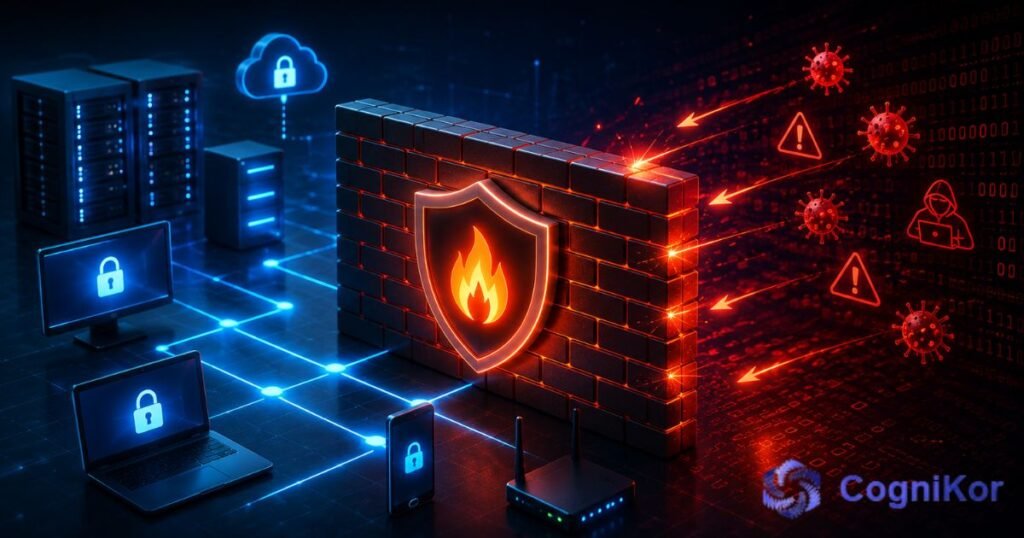
In an era where cyber threats evolve faster than traditional security teams can respond, firewall automation powered by artificial intelligence has become a critical necessity rather than a luxury. AI firewall automation represents a fundamental shift in how organizations approach network security moving from reactive, manual rule management to intelligent, adaptive, and proactive defense mechanisms.
This article explores what AI firewall automation is, why it matters, how it works, and how it’s transforming enterprise security operations.
Understanding the Problem: Why Traditional Firewalls Fall Short?
For decades, firewalls have been the backbone of network security. However, manual firewall management creates significant challenges:
- Manual Rule Management: Security teams must manually create, update, and maintain thousands of rules across multiple systems
- Human Error: Configuration complexity leads to mistakes that expose networks to attacks
- Scalability Issues: As networks grow, managing firewalls becomes increasingly difficult
- Time Constraints: Manual processes consume enormous resources, diverting attention from strategic initiatives
- Inconsistency: Different administrators implement rules inconsistently, creating security gaps
- Slow Response Times: Manual threat response is too slow in today’s threat landscape
What Is AI Firewall Automation?
AI firewall automation combines intelligent decision making with automation to eliminate manual firewall management. Unlike traditional automation that simply follows scripts, AI powered systems:
- Understand Security Intent: Analyze policies to comprehend what organizations are actually trying to achieve
- Learn from Behavior: Use machine learning to detect anomalies and predict risks before they materialize
- Adapt to Change: Continuously adjust security postures based on real time threats and network conditions
- Optimize Continuously: Refine rules to eliminate redundancy and improve both security and performance
- Provide Context Aware Decisions: Understand relationships between rules, services, and network zones
Core Capabilities of AI Firewall Automation

Policy Intelligence Engine: Parses and interprets security policies, identifies conflicts and redundancies, maps business requirements to technical configurations, and ensures alignment with best practices and compliance standards.
- Real Time Traffic Analysis & Learning: Continuously monitors network traffic to identify anomalies, detect threats, and provide insights for rule optimization. Machine learning algorithms improve accuracy over time by learning from threat patterns.
- Multi Vendor Support: Translates policies across different firewall platforms while preserving security intent, enabling organizations to manage heterogeneous environments efficiently.
- Automated Compliance Management: Continuously verifies configurations against compliance frameworks, automatically adjusts settings to meet regulatory requirements, and generates comprehensive audit trails and reports.
Key Benefits
Security: Tighter configurations through removal of redundant rules, real time threat detection and response, consistent policy enforcement, and proactive threat prediction.
- Operational Efficiency: Reduced manual workload for IT teams, faster policy deployments (minutes instead of days), and improved ability to scale without additional staffing.
- Risk & Compliance: Elimination of configuration errors, automated compliance checking, faster remediation of issues, and comprehensive visibility into security posture.
- Cost Savings: Lower operational costs through reduced manual labor, prevention of costly breaches, optimized firewall performance, and quick return on investment.
Real World Applications
Policy Optimization: Organizations accumulate redundant, outdated, and conflicting rules over time. AI analyzes thousands of rules to identify redundancies, resolve conflicts, and consolidate complexity while maintaining security a process known as “rule hardening” that improves both security and performance.
- Firewall Platform Migration: When migrating between vendors, AI handles policy translation and cross platform mapping while preserving security intent. This enables zero downtime migrations with validation before and after deployment, eliminating the traditional complexity of moving between different firewall platforms.
- Multi Vendor Environment Management: Organizations with firewalls from multiple vendors face inconsistent policies and complex management. AI synthesizes and harmonizes policies across all platforms, providing unified management and consistent governance.
- Compliance & Audit Automation: Instead of manual compliance checking, AI continuously verifies configurations against compliance frameworks, automatically flags violations, generates audit reports, and facilitates rapid remediation.
- Threat Response: When new threats emerge, AI enables rapid deployment of security rules, integration with threat intelligence feeds, automatic adjustments based on threat patterns, and automatic rollback if issues occur.
How AI Firewall Automation Works?
Modern AI firewall automation operates in a continuous cycle:
Assess: Analyze existing configurations to identify redundancies, conflicts, security gaps, and compliance issues.
- Recommend: Generate prioritized recommendations for rule consolidation, optimization, and security enhancements based on AI analysis.
- Deploy: Apply changes automatically through staged rollouts with version control and audit trails, minimizing risk.
- Validate & Monitor: Continuously verify that changes work correctly, monitor traffic patterns, and ensure legitimate flows aren’t disrupted.
- Optimize: Gather metrics on performance and effectiveness, identify new optimization opportunities, integrate threat intelligence, and loop back for continuous improvement.
This continuous cycle ensures firewall security remains aligned with evolving threats and business needs.
Industry Solutions for AI Firewall Automation
Solutions in the Market
Organizations looking to implement AI firewall automation have access to several sophisticated solutions:
- Cognifire is an AI powered security intelligence engine designed to transform firewall management from a manual, labor intensive process into an intelligent, automated operation. It focuses on understanding security intent and converting policies into optimized configurations. With capabilities for policy hierarchy optimization, rule refinement based on live traffic analysis, and multi vendor support, Cognifire helps organizations achieve both better security and improved operational efficiency. Learn more:
- Firekor addresses the specific challenge of firewall platform migration. It provides intelligent policy translation that understands not just the syntax but the underlying security logic of firewall rules. This enables organizations to migrate from one firewall platform to another without losing security intent or experiencing service disruptions. With automated validation and mapping across different vendor platforms, Firekor simplifies the complex process of firewall migration. Learn more:
These solutions represent examples of how AI firewall automation is evolving to address specific operational challenges that organizations face.
Implementation Best Practices
- Define Objectives: Identify specific problems to solve rule optimization, multi vendor management, compliance automation, or migration support.
- Assess Current State: Document existing firewall infrastructure, rule sets, and operational processes to understand complexity.
- Select Appropriate Solutions: Choose solutions aligned with your specific needs and long-term strategy.
- Plan Pilot Approach: Start with pilot implementations to validate the approach before enterprise-wide rollout.
- Establish Governance: Define how AI recommendations are reviewed and approved before deployment.
- Measure Impact: Track metrics like reduced rule count, fewer incidents, faster deployments, and improved compliance.
- Address Challenges: Plan for integration complexity, change management support, customization needs, and ongoing system tuning to optimize performance in your environment.
The Future of AI Firewall Automation
The field continues to evolve rapidly with emerging capabilities:
- Enhanced Threat Intelligence Integration: Deeper integration with real time threat feeds for faster response.
- Advanced Behavior Analysis: More sophisticated machine learning models to detect novel attacks and anomalies.
- Autonomous Response: Expanded capabilities for automatic threat response within defined parameters.
- Natural Language Policy Definition: Security teams will be able to define policies using plain language that AI systems convert to technical configurations.
- Cross Security Tool Orchestration: Coordination of firewall automation with other security tools for holistic protection.
- Predictive Security Posture Management: AI predicting and preventing security issues before they occur.
FAQ’s
Yes, AI firewalls use machine learning to predict and detect threats in real time with automated policy adjustments and a reduction in false positives. This allows security teams to focus on genuine threats rather than investigating numerous false alarms.
AI handles the heavy lifting in threat detection by sifting through millions of events, finding patterns, and automating responses, while humans provide oversight, context, and ethical judgment. AI driven automation eases the workload on IT teams by reducing the number of manual interventions required, allowing IT staff to focus on strategic initiatives.
AI based firewalls can autonomously initiate responses, such as isolating compromised devices, blocking traffic from suspicious IP addresses, or throttling unusual data flows. This enables immediate response to detected threats without waiting for human intervention.
Yes, 29% of organizations consider automating policy management a top priority in their transition to the cloud. AI firewalls matter because the scale, speed, and variability of modern threats have outpaced what static rules and manual analysis can reliably address.
Automation of firewall policy management enables enterprises to implement faster, error free changes that minimize downtime and help reduce risk, improve compliance, and increase operational efficiency across hybrid and multi cloud environments. This is especially critical as regulatory requirements continue to evolve.
Conclusion
AI firewall automation represents a fundamental transformation in network security. By combining automation precision with AI intelligence, these systems enable organizations to achieve superior security postures with less manual effort, respond faster to threats, maintain compliance, and scale efficiently.
As cyber threats evolve in sophistication, the shift from manual firewall management to AI driven automation is becoming essential for organizations serious about protecting their digital assets. The future belongs to those who embrace intelligent automation, freeing teams to focus on strategic initiatives while AI handles complex, repetitive work.
Solutions like Cognifire and Firekor represent different approaches to modern firewall automation: Cognifire focuses on policy optimization and continuous rule refinement; Firekor specializes in seamless cross platform migration. Organizations should evaluate solutions based on their specific priorities and operational needs.