Explore multi vendor network management with Synapse Grid. Map complex infrastructure, identify device relationships, automate topology design, and export diagrams.
Introduction
Managing a network built from multiple vendors can quickly become complex, especially as devices, sites, and network layers continue to grow. Teams need more than basic monitoring—they need a clear view of how hardware, connections, redundancy, and network architecture fit together. Multi-vendor network management helps bring this fragmented infrastructure into a unified view, while Synapse Grid uses AI-powered topology synthesis to turn network inventory into structured, interactive architecture.
Simplify Complex Network Infrastructure with Intelligent Network Visibility
Multi vendor network management is the practice of managing network infrastructure that contains equipment, technologies, and devices from different manufacturers through a coordinated management approach. Instead of treating every vendor environment as a separate system, modern network teams need a clear view of how devices, links, redundancy paths, and network layers work together.
This becomes especially important as enterprise networks grow across multiple sites and technology layers. Synapse Grid approaches this challenge from the network architecture and topology side, using AI to transform hardware inventory into structured, production-ready network topologies with architectural context.
Why Multi Vendor Network Management Becomes Difficult
Managing infrastructure from multiple vendors can make network architecture difficult to understand and maintain. Different hardware capabilities, device roles, connection types, and redundancy designs can create fragmented documentation and make it harder for engineers to understand the complete environment.
Common challenges include:
- ❌ Different vendors create inconsistent device roles and visual representations.
- ❌ Manual topology mapping becomes difficult as networks grow.
- ❌ HA relationships and redundancy paths can be difficult to represent accurately.
- ❌ Outdated diagrams make troubleshooting, planning, and documentation more difficult.
The impact can extend beyond documentation. When network teams lack an accurate architectural view, engineers may spend additional time identifying device relationships, validating connections, and updating diagrams whenever infrastructure changes.
A Smarter Approach to Multi Vendor Network Management
A modern approach combines hardware inventory, intelligent relationship discovery, automated topology generation, and interactive visualization. Instead of manually drawing every device and connection, network teams can use an automated system to convert infrastructure information into a structured network architecture.
Synapse Grid uses an AI-powered engine to correlate hardware information and identify relationships such as high-availability pairs, stack members, redundancy paths, and logical dependencies. It then synthesizes that information into organized network topology diagrams.
| Traditional Approach | Modern Approach with Synapse Grid |
| Manual network diagrams | AI-generated topology |
| Vendor-specific visual mapping | Multi-vendor device fingerprinting |
| Manually maintained hierarchy | Dynamic network hierarchy |
| Static connections | Interactive topology relationships |
| Separate documentation updates | Real-time topology recalculation |
| Manual exports | One-click PDF/SVG and other formats |
The result is a more structured way to understand complex multi-vendor infrastructure without relying entirely on manually maintained diagrams.
How Synapse Grid Supports Multi Vendor Network Management?
Synapse Grid is designed to turn hardware inventory into production-ready network architecture. Its multi-vendor fingerprinting capability identifies device roles, icons, and layer positioning based on hardware capabilities, helping create a consistent architectural view across different equipment types.
Key Features for Multi Vendor Network Management
- Multi-Vendor Fingerprinting: Identifies device roles and positioning based on hardware capabilities.
- Logic-Aware Discovery: Maps HA links, redundancy paths, and logical dependencies between devices.
- Dynamic Hierarchy: Organizes infrastructure into WAN, Edge, Core, Distribution, and Access layers.
- Telemetry Overlay: Visually differentiates connection types such as 100G Fiber, MPLS, Copper, and Management links.
A Practical Example
Consider an enterprise network containing multiple hardware vendors across WAN, core, distribution, and access layers. Instead of manually creating separate diagrams and attempting to connect the information, the team can upload its inventory into Synapse Grid.
The platform correlates the inventory, identifies logical relationships and HA structures, and generates an organized topology that provides architectural context across the environment.
How Synapse Grid Works
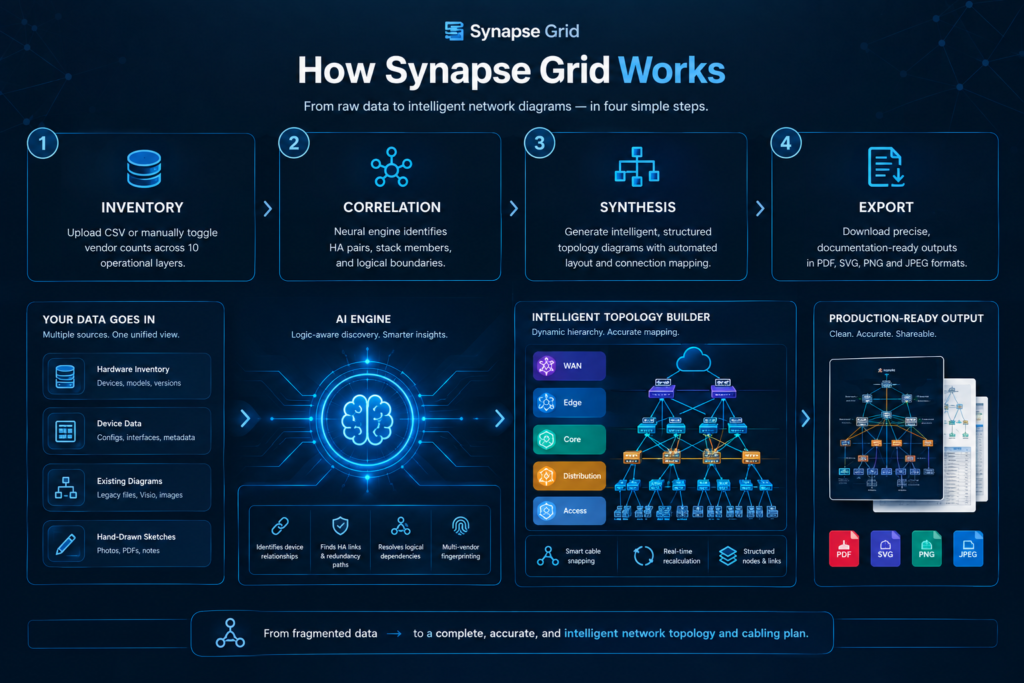
Synapse Grid follows a four-stage synthesis lifecycle: Inventory, Correlation, Synthesis, and Export. This workflow takes network information from raw hardware data through to documentation-ready architecture.
Step 1: Upload Network Inventory
The process begins with the network inventory. Synapse Grid allows users to upload CSV information or manually define vendor counts across operational layers.
This provides the foundation for generating the network architecture from available hardware information.
Step 2: Correlate Device Relationships
The AI engine analyzes the inventory to identify relationships between devices. This includes HA pairs, stack members, logical boundaries, and other architectural dependencies.
This correlation helps transform a collection of hardware records into meaningful network relationships.
Step 3: Synthesize the Network Topology
Synapse Grid generates structured topology diagrams using automated layout and connection mapping. Its dynamic hierarchy can organize devices into WAN, Edge, Core, Distribution, and Access layers.
The topology remains interactive, allowing users to modify nodes or links while the system recalculates paths and maintains structured diagrams.
Step 4: Export Documentation
Once the topology is complete, teams can export architecture diagrams in PDF, SVG, PNG, and JPEG formats.
This makes the generated topology useful for network documentation, architecture reviews, planning, and LLD/HLD materials.
Multi Vendor Network Management: Synapse Grid vs Traditional Tools
Multi-vendor management platforms can address different parts of network operations. For example, traditional network management products may focus on monitoring, configuration, performance, or troubleshooting. SolarWinds Network Performance Monitor, for example, provides multi-vendor monitoring and automatic discovery through protocols including ICMP, SNMP, and WMI.
Synapse Grid has a different focus: turning infrastructure inventory into intelligent network architecture and topology.
| Capability | Synapse Grid | Traditional Network Management / NMS Tools |
| Multi-vendor infrastructure visualization | Yes | Varies |
| AI-powered topology synthesis | Yes | Varies |
| Multi-vendor fingerprinting | Yes | Varies |
| HA relationship mapping | Yes | Depends on platform |
| Dynamic hierarchy | Yes | Depends on platform |
| Interactive topology editing | Yes | Depends on platform |
| Telemetry link visualization | Yes | Depends on platform |
| Large topology support | Yes | Depends on platform |
| PDF/SVG architecture export | Yes | Varies |
| Device configuration management | Not its primary focus | Common in some platforms |
| Performance monitoring | Not its primary focus | Common in NMS platforms |
The important distinction is that Synapse Grid should not be treated as a generic replacement for every network monitoring or configuration-management platform. Its value is centered on network architecture synthesis, topology visibility, and intelligent infrastructure mapping.
Benefits of Multi Vendor Network Management with Synapse Grid
1. Reduce Manual Network Documentation Work
Manually drawing and updating large network diagrams can consume significant engineering time. Synapse Grid automates topology generation and uses intelligent layout capabilities to reduce the amount of manual diagram construction required.
2. Improve Architectural Visibility
A multi-vendor network can contain thousands of devices and complex relationships. Synapse Grid provides dynamic hierarchy, global node search, and interactive topology capabilities to help teams navigate large distributed environments.
3. Make Device Relationships Easier to Understand
Understanding how devices connect is only part of network architecture. HA pairs, stack members, redundancy paths, and logical dependencies also matter. Synapse Grid’s logic-aware discovery is designed to expose these relationships in the generated architecture.
4. Support Large-Scale Network Designs
Synapse Grid is designed to handle large-scale topologies with thousands of nodes without performance degradation, while global node search helps users locate devices across distributed environments.
5. Produce Documentation-Ready Architecture
Network teams frequently need diagrams for architecture reviews, implementation planning, and technical documentation. Synapse Grid supports PDF, SVG, PNG, and JPEG exports, allowing generated topologies to be used beyond the interactive environment.
Key Features That Strengthen Multi Vendor Network Management
Multi-Vendor Fingerprinting
Different vendors may represent similar network functions through different hardware models and capabilities. Synapse Grid’s multi-vendor fingerprinting automatically assigns device roles, icons, and layer positions according to hardware capabilities.
Logic-Aware Discovery
Topology diagrams become more useful when they show logical relationships rather than simply placing devices on a canvas. Synapse Grid identifies HA links, redundancy paths, and logical dependencies to create a more meaningful architectural representation.
Smart Cable Snapping
Poorly organized diagrams can quickly become difficult to read. Synapse Grid uses smart cable snapping to connect links to relevant logical ports and reduce messy visual mapping.
Dynamic Network Hierarchy
Large networks become easier to interpret when devices are organized into logical layers. Synapse Grid automatically sorts nodes into WAN, Edge, Core, Distribution, and Access layers.
HA Boundary Logic
High-availability architectures can be difficult to represent clearly. Synapse Grid visually groups HA clusters within logical boundaries, helping engineers identify resilient portions of the infrastructure.
Real-Time Vector Ingestion
Network environments change continuously. Synapse Grid can recalculate topology layouts as inventory or configuration information changes, helping maintain an architecture that reflects the latest available information.
FAQ’s
Multi vendor network management refers to managing network infrastructure containing equipment from different manufacturers through a coordinated operational or architectural approach. It helps teams avoid treating every vendor environment as an isolated network and instead understand the infrastructure as a connected system.
Synapse Grid provides multi-vendor fingerprinting and is designed to transform hardware inventory into network architecture. However, the product page does not publish a complete list of supported vendors or claim universal compatibility, so specific hardware compatibility should be confirmed with CogniKor before deployment.
Synapse Grid’s published capabilities focus primarily on network architecture, topology synthesis, infrastructure relationships, and visualization rather than traditional performance monitoring. It should therefore be evaluated according to the specific network-management function a team needs.
Synapse Grid is designed to support topologies containing thousands of nodes. Features such as elastic scaling and global node search help users navigate large, distributed network environments more efficiently.
Yes. Synapse Grid supports exports in PDF, SVG, PNG, and JPEG formats. These outputs can be used for architecture documentation, technical reviews, and LLD/HLD materials.
Conclusion
Multi vendor network management becomes increasingly complex as organizations add more devices, vendors, sites, and network layers. Manual diagrams and fragmented documentation can make it difficult to maintain an accurate picture of the overall infrastructure.
Synapse Grid takes a specialized approach by using AI to correlate hardware information, identify relationships, synthesize network topology, and organize infrastructure into meaningful architectural layers.
For teams looking to improve network architecture visibility and reduce the manual effort involved in topology creation, Synapse Grid provides an intelligent workflow from inventory to documentation.