Improve network security with a Firewall Policy Audit. Find risky rules, remove outdated policies, reduce threats, and keep your firewall secure and compliant.
Introduction
Firewalls protect networks by controlling which traffic can enter, leave, or move between systems. But firewall rules can become difficult to manage as networks grow.
Old rules may stay in place. Similar rules may appear more than once. A rule may also make sense on one firewall platform but need a different structure when moved to another.
A firewall policy audit helps teams understand these rules before they become harder to manage.
For businesses that are also planning a firewall migration, reviewing the existing policies is an important starting point. Once teams know what their firewall is doing, they can move those policies to a new platform with greater clarity.
What Is a Firewall Policy Audit?
A firewall policy audit is a careful review of the rules inside a firewall.
Think of a firewall as a security guard standing at a gate. The firewall rules are the instructions given to that guard.
One rule might say:
- Allow this user.
- Block this connection.
- Let this server talk to another server.
- Allow traffic through a specific port.
- Send certain traffic to a particular destination.
A firewall policy audit checks whether those instructions still make sense.
Teams may review:
- Firewall rules
- Source and destination addresses
- Ports and services
- Network objects
- NAT rules
- VPN configurations
- Rule dependencies
- Policy order
- Unclear or duplicate rules
The main goal is to understand what the firewall is doing and whether its policies still match the needs of the network.
Why Is a Firewall Policy Audit Important?
Firewall environments change over time. New applications are added. Servers move. Networks grow. Security requirements change. Administrators create new rules to support these changes.
But older rules do not always disappear. This can leave a firewall with hundreds or even thousands of rules that are difficult to understand.
A regular firewall policy audit can help teams:
- Find outdated rules
- Identify duplicate policies
- Spot rules that are too broad
- Find unclear configurations
- Understand network access
- Improve firewall documentation
- Prepare configurations for future changes
- Make firewall migration easier to plan
The clearer the current configuration is, the easier it becomes to understand what should happen next.
What Should You Check During a Firewall Policy Audit?
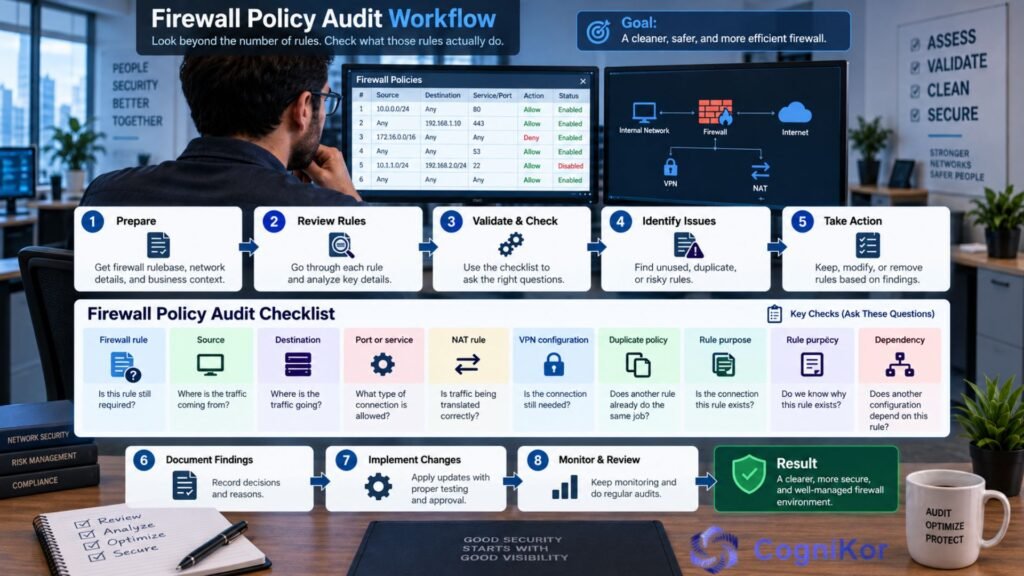
A good firewall policy audit looks beyond the number of rules. It checks what those rules actually do.
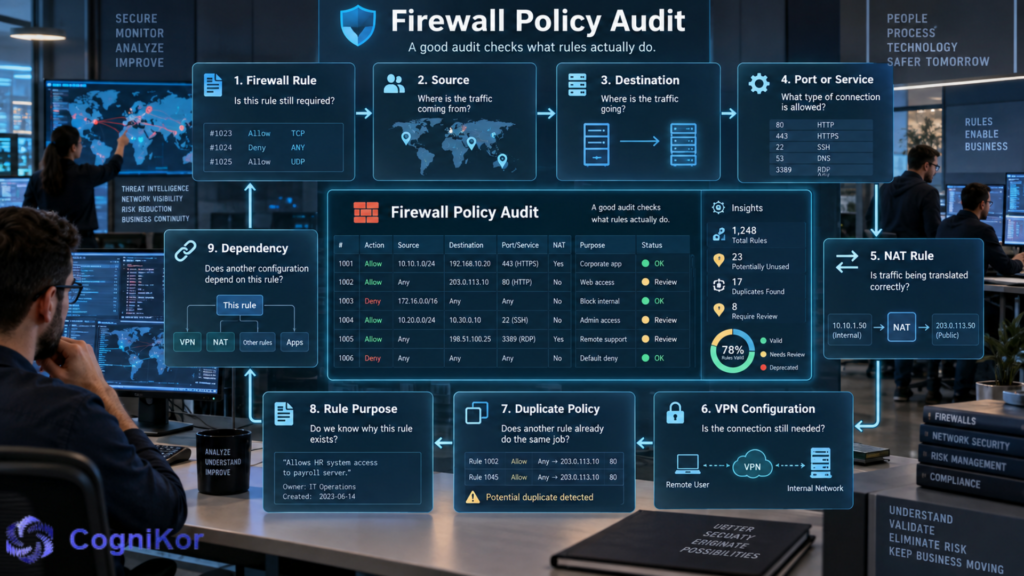
Here is a simple example:
| What to Check | Question to Ask |
| Firewall rule | Is this rule still required? |
| Source | Where is the traffic coming from? |
| Destination | Where is the traffic going? |
| Port or service | What type of connection is allowed? |
| NAT rule | Is traffic being translated correctly? |
| VPN configuration | Is the connection still needed? |
| Duplicate policy | Does another rule already do the same job? |
| Rule purpose | Do we know why this rule exists? |
| Dependency | Does another configuration depend on this rule? |
These checks help teams build a clearer picture of the firewall before making major changes.
Take Firewall Policy Review Further with FireKor
A firewall policy audit becomes especially useful when a business is preparing to move from one firewall platform to another.
FireKor is CogniKor’s AI-powered firewall migration solution. It is built to help organizations move firewall configurations between different platforms while keeping the original security intent in focus.
Instead of treating a firewall migration as simple text conversion, FireKor works with the logic behind firewall configurations.
Different firewall vendors may use different:
- Rule structures
- Configuration formats
- NAT methods
- Object models
- VPN settings
- Syntax
- Platform-specific features
So a configuration cannot always be copied from one firewall and pasted into another.
FireKor provides a structured way to understand, translate, validate, and prepare those configurations for the target platform.
Turn Existing Firewall Configurations Into a Clear Migration Starting Point
Before anything can be moved, teams need to know what already exists.
FireKor can work with an existing firewall configuration and identify its structure, vendor type, and important dependencies.
For example, an existing configuration may contain:
- Security policies
- NAT rules
- Network objects
- VPN settings
- Ports
- VLAN-related information
- Configuration dependencies
Instead of rebuilding everything from memory, the existing configuration becomes the foundation of the migration process.
Keep Firewall Policy Intent When Moving Between Vendors
One of the biggest challenges in firewall migration is that different vendors speak different configuration “languages.”
Imagine that Firewall A has a rule that means:
Allow the finance application to reach its database using only the required service.
Firewall B may express that same rule differently.
Simply converting words or syntax is not enough. The important part is keeping the meaning of the security rule.
FireKor’s policy translation approach is designed around this problem.
It helps map firewall policies across platforms while keeping their intended behavior in mind.
This can be especially useful when moving between different firewall technologies because teams do not have to treat every policy as a simple one-to-one text conversion.
Use Multi-Vendor Intelligence for Complex Firewall Environments
Many organizations do not use only one firewall vendor.
They may have:
- One firewall platform at the main office
- Another at branch locations
- Older devices in legacy environments
- Newer platforms being introduced during infrastructure upgrades
A rule structure that works for one vendor may not work the same way for another.
FireKor is designed with multi-vendor firewall intelligence so that the target platform can be considered during translation.
The basic idea is simple:
Understand the source → understand the target → map the policy correctly.
| Traditional Challenge | FireKor Approach |
| Different vendor syntax | Vendor-aware translation |
| Different policy structures | Cross-platform policy mapping |
| Complex dependencies | Configuration dependency handling |
| Large configurations | Structured migration processing |
| Policy behavior changes | Focus on preserving security intent |
| Difficult review | Validation and comparison |
Translate Firewall Policies Without Starting From Zero
Manual firewall migration can require engineers to rebuild configurations rule by rule.
For a small firewall, that may already take considerable attention.
For an enterprise environment with a large configuration, the task becomes much more difficult.
The platform can translate existing configurations into the syntax required by the target firewall while keeping policy behavior in focus.
This can reduce repetitive manual work involving:
- Recreating rules
- Mapping objects
- Translating configuration structures
- Checking dependencies
- Comparing source and target policies
- Preparing configurations for the new platform
Automation does not mean human review becomes unnecessary.
Instead, it gives engineers a structured output they can inspect and validate.
Validate Before the New Firewall Goes Live
Migration should not end when a configuration has been translated.
FireKor includes validation as part of its migration workflow so teams can review configurations before deployment.
Validation can help answer questions such as:
- Was the configuration translated correctly?
- Does the target configuration match the expected behavior?
- Are important dependencies still present?
- Are there warnings that need attention?
- Does anything need to be reviewed before deployment?
This gives teams another checkpoint before the new firewall configuration is used in production.
Compare the Source and Target Configurations
When a firewall migration involves many rules, remembering every original setting is unrealistic.
FireKor supports reviewing source and translated configurations so engineers can inspect what changed during the migration.
This makes it easier to answer:
What did we have before, and what will we have after the migration?
A clear comparison can be useful for:
- Technical review
- Migration approval
- Troubleshooting
- Internal documentation
- Post-migration checks
Get Clear Migration Reports
A firewall migration can produce a lot of technical information.
Without clear reporting, teams may struggle to understand what happened during translation.
FireKor includes an audit and reporting capability that can provide information around mappings, warnings, and optimization recommendations.
A migration report can help teams see:
- What was translated
- How policies were mapped
- Where warnings appeared
- Which areas may need review
- Where optimization may be possible
This creates a clearer record of the migration instead of leaving the process hidden inside manual configuration work.
A Simple FireKor Firewall Migration Workflow
FireKor turns firewall migration into a clear workflow.
| Stage | What Happens |
| 1. Import | Bring the existing firewall configuration into the migration process. |
| 2. Validate | Check the configuration and identify issues that need attention. |
| 3. Translate | Convert the configuration for the target firewall while preserving intended behavior. |
| 4. Validation & Export | Compare results, validate the output, and prepare the configuration for deployment. |
This gives teams a repeatable path from an existing firewall to a deployment-ready configuration.
Manual Firewall Migration vs FireKor
Manual migration can work, but complexity grows quickly as the number of policies, objects, devices, and vendor differences increases.
Here is a simple comparison:
| Area | Manual Migration | FireKor |
| Policy translation | Engineers translate rules manually | Automated policy translation |
| Vendor differences | Checked manually | Multi-vendor intelligence |
| Policy mapping | Recreated by engineers | Cross-platform policy mapping |
| Dependencies | Tracked manually | Dependencies considered during processing |
| Validation | Requires separate manual checks | Validation built into the workflow |
| Comparison | Often performed manually | Source and target comparison |
| Reporting | Created separately | Migration reporting |
| Large environments | More repetitive work | Built for scalable migration workflows |
FireKor does not replace the need for security expertise. It helps engineers spend less time on repetitive translation work and more time reviewing important security decisions.
Connect Firewall Policy Auditing With Smarter Migration
A firewall policy audit tells you what is happening inside your current firewall.
FireKor helps you decide how that configuration should move to the next firewall platform.
Together, the process becomes easier to understand:
Audit → Understand → Import → Validate → Translate → Validate → Export
This is particularly useful when an organization is replacing legacy firewalls, standardizing different firewall platforms, or moving configurations across vendors.
Why Use FireKor for Firewall Migration?
Firewall migrations can become complicated because policies are connected to many other configuration elements.
FireKor provides a structured approach built around:
- AI-powered firewall migration
- Policy translation
- Cross-platform mapping
- Multi-vendor firewall intelligence
- Configuration validation
- Source and target comparison
- Migration reporting
- Configuration export
- Large-environment support
The aim is not simply to create a new configuration file. The aim is to move firewall configurations while keeping the intended security behavior clear and consistent.
FAQ’s
Unused firewall rules are policies that no longer serve an active business or network requirement. They can make firewall management more complex and should be reviewed before removal.
Redundant rules are firewall policies that duplicate or overlap with other rules. Finding them during an audit can simplify the rulebase and make firewall management easier.
Yes. Regular firewall audits can help organizations demonstrate that security policies and access controls are being reviewed and maintained according to applicable compliance requirements.
Without regular audits, outdated permissions, unnecessary access, configuration errors, and conflicting rules can remain in place. This may increase security risks and make the firewall harder to manage.
Yes. Security and network management tools can automate parts of the audit process by analyzing firewall configurations, identifying risky rules, detecting policy issues, and helping teams prioritize changes.
Conclusion
A Firewall Policy Audit is an important part of keeping a network secure, organized, and easy to manage. Over time, firewall rules can become outdated, duplicated, overly broad, or unnecessary. Regular audits help identify these issues before they create security gaps.
By reviewing firewall policies, organizations can reduce unnecessary access, simplify complex rule sets, and improve overall network security. Audits can also support compliance efforts by helping teams maintain clear and controlled security policies.
A consistent Firewall Policy Audit process gives IT and security teams better visibility into firewall configurations and helps ensure that rules continue to match current business and security needs.