

Simplify HLD network design with Synapse Grid. Create AI-powered network topologies, map device relationships, and generate accurate architecture diagrams.
Introduction
Designing an enterprise network requires careful planning, accurate documentation, and a clear understanding of how network devices connect. HLD network design provides the architectural foundation for building scalable, secure, and reliable network infrastructures.
However, traditional high-level network design often involves manually organizing devices, identifying connections, and preparing topology diagrams. These processes become increasingly challenging as enterprise networks expand across multiple locations and hardware vendors.
Synapse Grid by CogniKor simplifies this process through AI-powered network design. It transforms hardware inventory into structured network topologies, helping engineers visualize infrastructure, identify device relationships, and prepare documentation-ready architecture diagrams.
What Is HLD Network Design?
HLD (High-Level Design) network design defines the overall architecture of a network infrastructure. It provides a conceptual overview of how switches, routers, firewalls, network segments, and other essential components connect and interact.
Unlike detailed implementation documentation, an HLD focuses on the network’s structure, major technologies, connectivity, and design requirements.
A typical HLD network design includes:
- Network topology: A visual representation of the overall infrastructure.
- Network architecture: Core, distribution, access, WAN, and edge layers.
- Security architecture: Firewall placement and network segmentation.
- High availability: Redundant devices and alternative connectivity paths.
- Scalability planning: Architectural considerations for future expansion.
- Technology selection: Major hardware platforms and networking technologies.
A well-defined HLD helps stakeholders understand the proposed network before implementation begins. It also provides a foundation for developing detailed technical documentation.
Cisco’s network design guidance similarly emphasizes architectural planning based on business requirements, network topology, and technology decisions.
HLD vs. LLD Network Design: What’s the Difference?
HLD and LLD serve different purposes during network infrastructure planning.
High-Level Design (HLD) describes the overall network architecture, while Low-Level Design (LLD) defines the technical details required to implement that architecture.
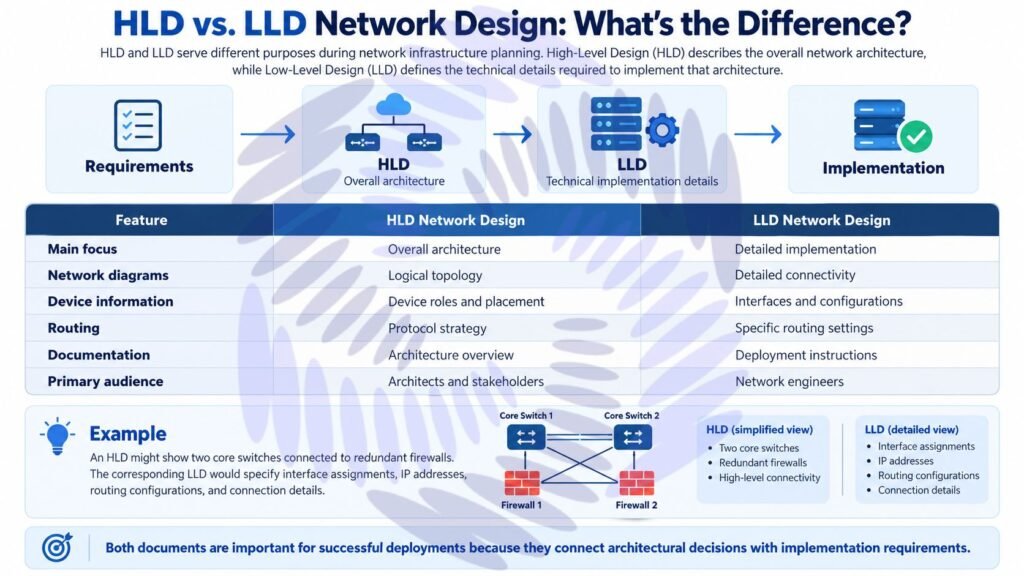
| Feature | HLD Network Design | LLD Network Design |
| Main focus | Overall architecture | Detailed implementation |
| Network diagrams | Logical topology | Detailed connectivity |
| Device information | Device roles and placement | Interfaces and configurations |
| Routing | Protocol strategy | Specific routing settings |
| Documentation | Architecture overview | Deployment instructions |
| Primary audience | Architects and stakeholders | Network engineers |
For example, an HLD might show two core switches connected to redundant firewalls. The corresponding LLD would specify interface assignments, IP addresses, routing configurations, and connection details.
Both documents are important for successful deployments because they connect architectural decisions with implementation requirements.
Simplify HLD Network Design with Synapse Grid
Creating high-level network designs manually can require significant engineering effort, especially when infrastructure contains hundreds of devices and multiple hardware vendors.
Synapse Grid addresses these challenges by combining AI-powered topology generation, hardware-aware device identification, and intelligent connection mapping.
Instead of manually arranging every device, engineers can provide network inventory information and use Synapse Grid to generate structured architectural diagrams.
The platform supports network design requirements through several capabilities:
- Automatic organization of devices into logical network layers.
- Identification of high-availability connections and dependencies.
- Multi-vendor hardware recognition and classification.
- Interactive network topology visualization.
- Intelligent connection mapping between devices.
- Exportable diagrams suitable for HLD and LLD documentation.
This approach reduces repetitive diagramming work while giving network engineers more time to evaluate architectural decisions.
How Synapse Grid Automates HLD Network Design?
Synapse Grid follows a structured four-stage workflow that transforms network inventory into documentation-ready architecture diagrams.
Step 1: Upload Network Inventory
The process begins with hardware information. Engineers can upload CSV inventory files or manually enter vendor and device quantities.
This establishes the network components that need to be included in the architecture.
Step 2: Identify Device Relationships
Synapse Grid uses its correlation engine to identify logical relationships between network devices.
These relationships may include:
- High-availability device pairs.
- Redundant connectivity paths.
- Network stack members.
- Logical infrastructure boundaries.
- Dependencies between network components.
Step 3: Generate the Network Topology
After analyzing the inventory, Synapse Grid creates a structured topology using automated device placement and connection mapping.
Its dynamic hierarchy organizes devices into WAN, Edge, Core, Distribution, and Access layers.
Engineers can then review the architecture and modify nodes or links as required.
Step 4: Export HLD Documentation
Once the topology has been reviewed, diagrams can be exported in PDF, SVG, PNG, and JPEG formats.
These outputs can be incorporated into HLD documents, technical presentations, infrastructure planning materials, and subsequent LLD documentation.
Key Synapse Grid Features for High-Level Network Design
Synapse Grid provides several capabilities designed to simplify complex enterprise architecture planning.
Logic-Aware Network Discovery
The platform identifies device relationships, high-availability paths, and logical dependencies.
This helps engineers understand how infrastructure components interact rather than viewing devices as isolated objects.
Multi-Vendor Network Support
Enterprise networks often contain hardware from different manufacturers.
Synapse Grid supports vendors including Cisco, Fortinet, HPE Aruba, and Huawei, helping engineers organize mixed-vendor infrastructure within a consistent topology.
Dynamic and Interactive Diagrams
Static network diagrams become difficult to maintain when infrastructure requirements change.
Synapse Grid supports interactive modifications and topology recalculation, allowing engineers to refine network layouts as designs evolve.
High-Availability Visualization
Redundancy is an important consideration in enterprise HLD network design.
Synapse Grid identifies high-availability relationships and uses logical boundaries to represent HA clusters, making resilient network architectures easier to understand.
Enterprise-Scale Topology Management
Large networks may contain thousands of devices across multiple locations.
Synapse Grid offers elastic scaling and global node search to help engineers navigate complex distributed topologies.
Traditional HLD Network Design vs. Synapse Grid
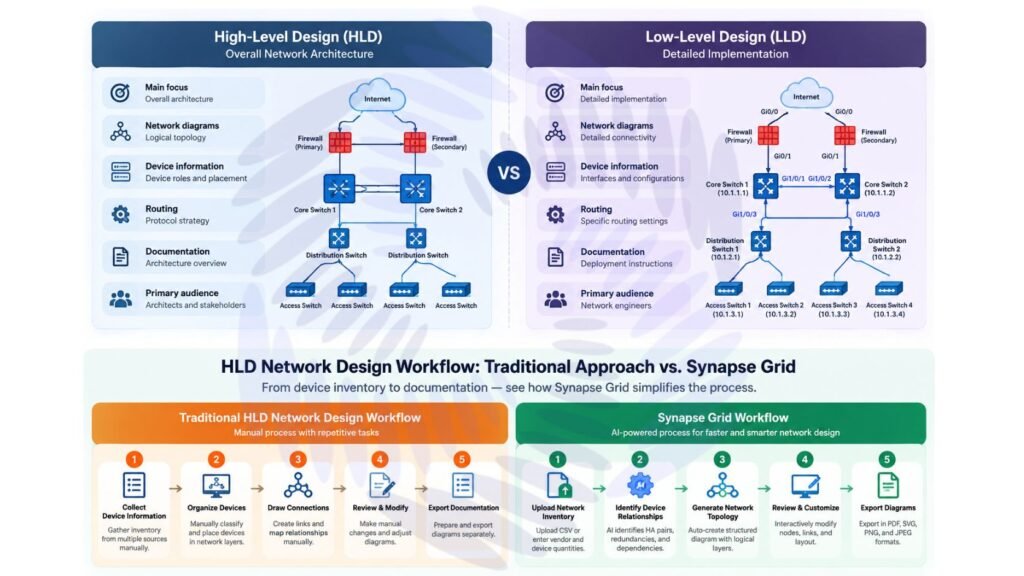
Traditional network diagramming requires engineers to perform many repetitive design activities manually.
Synapse Grid introduces AI-assisted capabilities that simplify topology creation and documentation.
| Design Activity | Traditional Approach | Synapse Grid |
| Device organization | Manual placement | Automated hierarchy |
| Connection mapping | Manually drawn links | Intelligent link mapping |
| Vendor identification | Manual classification | Multi-vendor fingerprinting |
| HA visualization | Manually illustrated | Logic-aware HA mapping |
| Topology changes | Manual diagram revisions | Dynamic recalculation |
| Documentation | Separate export preparation | PDF, SVG, PNG, JPEG exports |
Synapse Grid does not eliminate the need for architectural review. Engineers remain responsible for validating the design against business requirements, security policies, and deployment constraints.
However, automating repetitive topology tasks can make HLD preparation more efficient and manageable.
Why Choose Synapse Grid for Enterprise HLD Network Design?
Enterprise network architecture must support business growth, operational resilience, and infrastructure visibility.
Synapse Grid helps organizations achieve these objectives by creating a more structured network design workflow.
Its benefits include:
- Improved efficiency: Reduce time spent manually constructing network diagrams.
- Better visibility: Understand network layers, connectivity, and dependencies.
- Consistent architecture: Organize multi-vendor devices into structured topologies.
- Simplified documentation: Generate diagrams suitable for architecture reviews and project handovers.
- Greater flexibility: Adjust topology layouts as infrastructure requirements evolve.
- Scalable planning: Visualize large enterprise and data center environments.
For organizations modernizing their network infrastructure, Synapse Grid provides a practical way to turn hardware information into understandable architectural designs.
FAQs
The essential components include network topology, core and distribution layers, routers, switches, firewalls, redundancy planning, and logical connectivity. These elements help create a scalable and reliable network architecture.
AI simplifies HLD network design by automating device organization, topology generation, and connection mapping. Tools like Synapse Grid help reduce manual diagramming efforts and improve network visualization.
Yes, Synapse Grid is designed to support complex enterprise environments. It helps engineers organize multi-vendor devices, visualize network relationships, and manage large-scale network topologies efficiently.
Yes. A well-planned HLD network design can help reduce downtime risks by incorporating redundancy, high availability, and resilient connectivity. Synapse Grid supports this planning through HA relationship mapping and network topology visualization.
Synapse Grid can generate structured network topology diagrams that support HLD documentation and provide a foundation for LLD preparation. Engineers can further refine the diagrams and add implementation-specific details as needed.
Conclusion
Effective HLD network design establishes a strong foundation for scalable, reliable, and well-documented network infrastructure. However, manually creating and maintaining enterprise network diagrams can become increasingly complex.
Synapse Grid simplifies this process through AI-powered topology generation, logic-aware relationship mapping, multi-vendor support, and documentation-ready exports.
By transforming hardware inventory into structured architecture diagrams, the platform helps network engineers focus on improving infrastructure design rather than repetitive diagramming tasks.
Ready to simplify your HLD network design process? Explore Synapse Grid by CogniKor and discover a smarter approach to enterprise network architecture.