Enterprise network architecture design is the process of planning how an organization’s routers, switches, firewalls, WAN connections, access devices, data centers, and other infrastructure components should connect and operate as one scalable network.
Modern enterprise environments can contain hundreds or thousands of devices across multiple locations. Designing those environments manually can require extensive inventory analysis, topology mapping, relationship identification, connection planning, and documentation. Synapse Grid approaches this process differently by transforming hardware and network information into structured, production-ready network topologies with architectural context.
How AI Improves Enterprise Network Architecture Design
A strong enterprise architecture needs more than a collection of device icons and connection lines. It must show how devices relate to one another, where redundancy exists, how network layers are organized, and how the architecture can change as the infrastructure grows.
Traditional design workflows often require engineers to manually place devices, draw connections, organize network layers, identify high-availability relationships, and repeatedly update diagrams. Synapse Grid uses AI-assisted analysis and dynamic topology capabilities to automate much of this repetitive work.
Common Enterprise Network Design Problems
Complex network architecture projects can become difficult when information is spread across inventories, spreadsheets, legacy diagrams, and configuration data.
- ❌ Manual topology creation can consume days of engineering time.
- ❌ Large device inventories are difficult to organize accurately.
- ❌ Redundant and high-availability relationships can be overlooked.
- ❌ Network diagrams can become outdated after infrastructure changes.
The impact goes beyond diagram quality. Poor or outdated documentation can make troubleshooting, upgrades, architecture reviews, and future expansion more difficult. Network design guidance commonly emphasizes scalability, reliability, redundancy, performance, security, and accurate documentation as important design considerations.
What Is Enterprise Network Architecture Design?
Enterprise network architecture design defines the structure and relationships that allow an organization’s network infrastructure to operate efficiently and scale with business requirements.
It can include physical and logical topology, network layers, device roles, redundancy, connectivity, segmentation, WAN architecture, data-center infrastructure, and connections between different sites and environments.
For a large organization, the architecture may involve WAN, Edge, Core, Distribution, and Access layers. Synapse Grid can automatically organize nodes into these layers while using hardware capabilities to help determine device roles and positioning.
Traditional vs. AI-Assisted Network Architecture Design
| Traditional Approach | AI-Assisted Approach with Synapse Grid |
| Devices positioned manually | Devices organized automatically |
| Connections drawn individually | Automated connection mapping |
| HA relationships identified manually | Logic-aware HA discovery |
| Network layers organized manually | Dynamic hierarchy |
| Diagrams updated manually | Real-time topology recalculation |
| Large diagrams become difficult to navigate | Global node search and elastic scaling |
| Documentation prepared separately | Direct PDF, SVG, PNG and JPEG export |
The goal is not to remove the network engineer from the design process. Instead, Synapse Grid handles repetitive topology work so engineers can spend more time reviewing architecture, validating requirements, and making technical decisions.
Why Synapse Grid Fits Enterprise Network Architecture Design
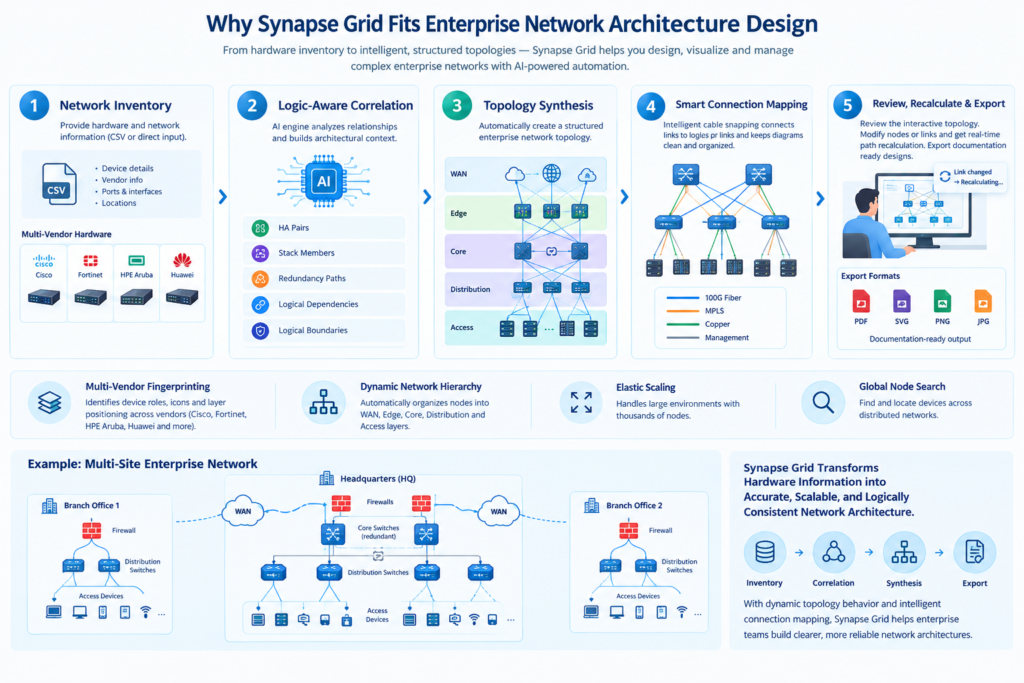
Synapse Grid is specifically designed to transform hardware information into accurate, scalable, and logically consistent network architecture. Its product workflow combines inventory, relationship correlation, topology synthesis, and documentation export.
1. Logic-Aware Discovery
Synapse Grid identifies relationships between devices and can map high-availability links, redundancy paths, and logical dependencies. This gives the architecture more context than a simple collection of disconnected device icons.
2. Multi-Vendor Fingerprinting
Enterprise networks frequently contain hardware from different vendors. Synapse Grid uses hardware capabilities to assign device roles, icons, and layer positioning and supports environments involving vendors such as Cisco, Fortinet, HPE Aruba, and Huawei.
3. Dynamic Network Hierarchy
The platform can automatically organize network nodes into WAN, Edge, Core, Distribution, and Access layers. This makes large architectures easier to interpret and provides a structured starting point for engineering review.
4. Smart Cable Snapping
Connections can become visually confusing when hundreds of links cross a diagram. Synapse Grid uses intelligent cable snapping to connect links to relevant logical ports and reduce messy topology mapping.
Example: Designing a Multi-Site Enterprise Network
Consider an organization operating multiple offices, WAN connections, redundant core switches, firewalls, distribution switches, and hundreds of access devices.
Instead of manually creating every device and connection, the team can provide its inventory to Synapse Grid. The system can correlate device relationships, organize network layers, synthesize the topology, and provide a structured architecture for engineering review.
As the infrastructure changes, the topology can also recalculate its layout when inventory or configurations change.
How Synapse Grid Works for Enterprise Network Architecture Design
Synapse Grid uses a four-stage synthesis lifecycle: Inventory, Correlation, Synthesis, and Export.
Step 1: Add Network Inventory
The workflow starts with infrastructure information. Users can upload CSV data or manually configure vendor counts across operational layers.
This gives Synapse Grid the hardware information needed to begin constructing the architecture rather than requiring engineers to start with an empty diagram.
Step 2: Correlate Devices and Relationships
The system analyzes the infrastructure information to identify relationships such as HA pairs, stack members, redundancy paths, and logical boundaries.
This correlation stage is important because enterprise architecture is about how devices work together, not simply where individual devices are located.
Step 3: Synthesize the Network Topology
Synapse Grid generates a structured topology with automated layout and connection mapping.
Its dynamic SVG interaction also allows users to modify nodes or links while the system recalculates paths in real time, helping maintain an organized architecture as changes are made.
Step 4: Export Documentation
After reviewing the architecture, teams can export the finished design in PDF, SVG, PNG, or JPEG formats.
PDF and SVG exports can be used for high-level design and low-level design documentation workflows, giving engineering teams a practical way to move from topology creation to project documentation.
Synapse Grid vs. Other Network Design Approaches
Enterprise network architecture can be supported by several types of tools, including documentation platforms, diagramming applications, vendor-specific design systems, and professional network design services. These approaches solve different parts of the overall problem.
| Capability | Synapse Grid | NetBox | General Diagramming Tools | Traditional Design Services |
| AI-assisted topology synthesis | Yes | Not the primary focus | Usually no | Depends on provider |
| Hardware-aware device roles | Yes | Documentation-focused | Usually manual | Engineer-driven |
| HA relationship discovery | Yes | Can document relationships | Usually manual | Engineer-driven |
| Dynamic topology interaction | Yes | Topology visualization available | Depends on tool | Depends on deliverable |
| Multi-vendor architecture | Yes | Multi-vendor documentation possible | Manual | Depends on engineers |
| Smart cable snapping | Yes | Not its primary function | Varies | Manual or tool-dependent |
| Thousands of nodes | Designed for large-scale topologies | Designed for infrastructure documentation | Varies significantly | Depends on project |
| PDF/SVG export | Yes | Documentation/export capabilities vary | Common | Usually delivered as documentation |
| Pricing | Contact vendor | Pricing depends on offering | Varies | Project-based |
| Support model | CogniKor contact/engagement | Vendor support options | Depends on product | Service provider |
NetBox, for example, emphasizes documentation, infrastructure modeling, topology visualization, and maintaining a centralized source of truth, while Synapse Grid’s product positioning focuses on AI-assisted synthesis of network architecture from infrastructure information.
For exact commercial pricing, organizations should request current pricing directly from the respective vendors because pricing can depend on deployment, scale, licensing, and service requirements.
Benefits of AI-Powered Enterprise Network Architecture Design
1. Reduce Manual Design Time
CogniKor states that Synapse Grid can produce network designs in under two minutes compared with a stated manual range of three to ten days. These are vendor-reported figures rather than independently verified performance benchmarks, so actual time savings can vary by project complexity and input quality.
Reducing repetitive diagramming work allows engineers to focus more attention on architecture validation, requirements, capacity, redundancy, and implementation planning.
2. Improve Connection Accuracy
Synapse Grid’s smart cable snapping and logic-aware discovery are designed to reduce connection-mapping problems and maintain structured diagrams. CogniKor states that its cabling error rate can approach 0%, compared with a stated 15–25% baseline; these figures should be treated as product claims rather than universal industry benchmarks.
For complex enterprise environments, structured connection mapping can make architecture review easier and reduce the amount of manual diagram cleanup.
3. Make Large Networks Easier to Manage
Enterprise networks can contain thousands of nodes. Synapse Grid includes elastic scaling for large topologies and global node search for quickly locating devices across multi-site architectures.
This becomes particularly useful when a network contains multiple locations, redundant infrastructure, and several network layers.
4. Keep Architecture Current
A network diagram becomes less useful when it no longer represents the infrastructure it describes.
Synapse Grid’s real-time vector ingestion can recalculate topology layout as inventory or configurations change, helping teams maintain a more dynamic representation of the architecture.
Key Enterprise Network Architecture Features to Look For
When evaluating an enterprise network architecture design solution, organizations should consider more than diagram appearance.
Scalability
The platform should remain practical as the number of devices, locations, and connections increases.
Redundancy Visibility
HA pairs, redundant paths, and logical dependencies should be easy to identify during architecture reviews.
Multi-Vendor Support
Organizations with mixed infrastructure should be able to represent hardware from multiple manufacturers without rebuilding diagrams manually.
Dynamic Updates
Network architecture should be capable of adapting when devices and configurations change.
Documentation
The final architecture should be available in formats suitable for engineering documentation, reviews, implementation, and future maintenance.
Synapse Grid addresses these requirements through elastic scaling, HA boundary logic, multi-vendor fingerprinting, real-time vector ingestion, and PDF/SVG/PNG/JPEG export.
Frequently Asked Questions About Enterprise Network Architecture Design
1. What is enterprise network architecture design?
Enterprise network architecture design is the process of defining how an organization’s network devices, connectivity, layers, redundancy, and logical relationships should work together.
It provides a structured blueprint for networks that may include campus environments, WANs, data centers, branches, cloud connectivity, and security infrastructure.
2. How can AI help with enterprise network architecture design?
AI can analyze network inventory and device information to identify relationships, organize devices, and generate structured topology diagrams.
Synapse Grid uses logic-aware discovery, multi-vendor fingerprinting, dynamic hierarchy, automated connection mapping, and real-time topology recalculation to automate parts of this process.
3. How much does Synapse Grid cost?
The Synapse Grid product page does not publish a specific price, so a current commercial quote should be requested from CogniKor.
Pricing for enterprise network design platforms can depend on network size, requirements, deployment model, and other commercial factors. The appropriate way to establish ROI is to compare licensing or service costs with the organization’s existing design effort, engineering time, and documentation requirements.
4. Can Synapse Grid work with multi-vendor networks?
Yes. CogniKor states that Synapse Grid works across Cisco, Fortinet, HPE Aruba, Huawei, and other vendors.
Its multi-vendor fingerprinting capability uses hardware capabilities to assign device roles, icons, and layer positioning within the topology.
5. Can Synapse Grid create documentation-ready network diagrams?
Yes. Synapse Grid can export architecture designs in PDF, SVG, PNG, and JPEG formats.
The product page specifically positions PDF and SVG exports for high-level and low-level design documentation workflows.
Start Designing Enterprise Networks with Synapse Grid
Enterprise network architecture design becomes increasingly challenging as organizations add devices, locations, vendors, connections, and redundancy requirements.
Synapse Grid provides an AI-assisted workflow that moves from inventory and device information to relationship correlation, topology synthesis, dynamic architecture management, and documentation-ready exports.
Start Designing with Synapse Grid
For organizations evaluating modern network architecture workflows, Synapse Grid can provide a structured way to reduce repetitive topology work while keeping engineers involved in architecture review and validation.
Conclusion
Enterprise network architecture design provides the blueprint for how an organization’s network infrastructure connects, scales, and evolves. As environments become larger and more multi-vendor, manually creating and maintaining architecture diagrams can become increasingly demanding.
Synapse Grid addresses this challenge by combining AI-powered network design, logic-aware discovery, multi-vendor fingerprinting, dynamic hierarchy, HA mapping, smart cable snapping, elastic scaling, global node search, and real-time topology updates.
For teams looking to move from raw hardware inventory to structured network architecture more efficiently, Synapse Grid offers a workflow designed to connect infrastructure information with visual, documentation-ready network topology.