Simplify firewall configuration migration with FireKor. Translate policies, NAT rules, and VPN configurations across firewall platforms while preserving security intent.
Introduction
Modern networks rarely stay on the same security platform forever. Businesses upgrade aging hardware, consolidate vendors, adopt new technologies, and replace legacy firewalls as infrastructure requirements evolve.
The difficult part is not simply installing the new firewall. It is transferring years of security policies, NAT rules, VPN configurations, objects, dependencies, and network logic without changing how the environment is supposed to behave.
This is where firewall configuration migration becomes critical to a successful firewall transition.
Traditional migration methods often require engineers to interpret and rebuild configurations for a different vendor manually. FireKor by CogniKor takes a different approach by using intelligent automation to translate firewall configurations while preserving their underlying security intent.
What Is Firewall Configuration Migration?
Firewall configuration migration is the process of transferring firewall rules, policies, network objects, NAT configurations, VPN settings, and related logic from an existing firewall environment to a new platform.
This may be required when an organization is:
- Replacing legacy firewall hardware
- Moving from one firewall vendor to another
- Standardizing security infrastructure
- Consolidating multiple firewall platforms
- Modernizing enterprise network infrastructure
- Deploying new firewall technology across multiple sites
A migration is more complicated when the source and destination devices come from different vendors.
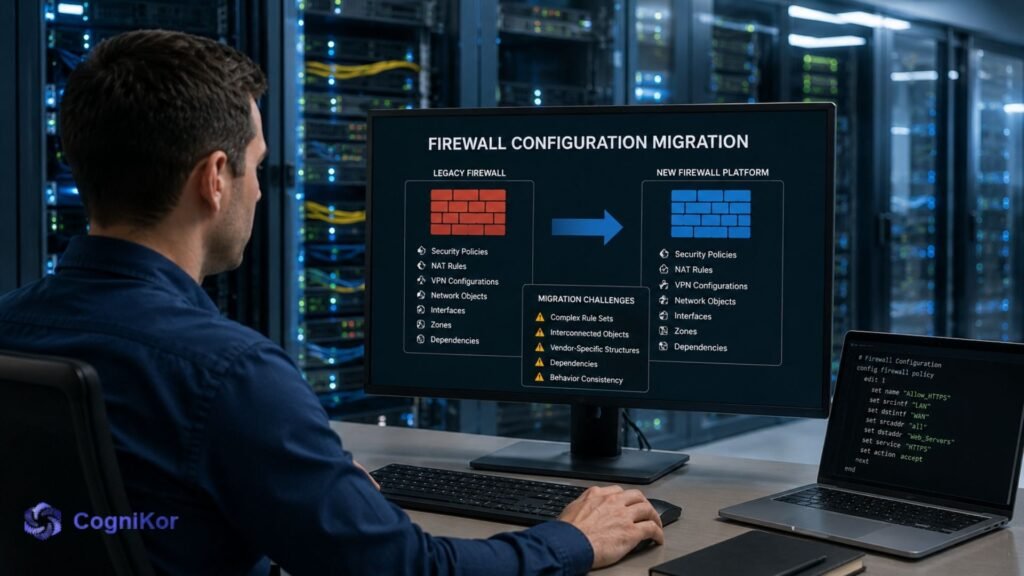
Different firewall vendors use different configuration structures, syntax, capabilities, object models, and policy logic. A rule that works correctly on one platform may therefore require a different implementation on another.
Why Firewall Configuration Migration Can Become Complex
A firewall configuration represents much more than a list of allowed and blocked connections.
Over time, enterprise firewalls can accumulate large rule sets, interconnected network objects, NAT policies, VPN configurations, and dependencies. Moving these configurations requires understanding what each component is intended to accomplish.
A typical migration may involve:
- Firewall security policies
- Source and destination objects
- Network and service objects
- NAT rules
- VPN configurations
- Interfaces and ports
- Zones
- Dependencies between policies
- Vendor-specific configuration structures
Simply copying configuration text is usually not enough when moving between different platforms.
The destination firewall must receive a configuration that reflects the intended behavior of the source environment while also following the structure and capabilities of the new platform.
The Traditional Approach to Firewall Migration
Many organizations still approach firewall migrations as heavily manual engineering projects.
Teams export the existing configuration, study the rule base, identify objects and dependencies, and then recreate or convert those configurations for the destination platform.
A simplified traditional process may look like this:
- Export the source firewall configuration.
- Review existing rules and objects.
- Identify dependencies.
- Map source features to destination features.
- Rewrite configurations in the new vendor’s syntax.
- Review translated rules.
- Validate the resulting configuration.
- Prepare the configuration for deployment.
This approach can work, but complexity grows rapidly with larger environments.
The more rules, devices, sites, VPNs, NAT policies, and vendor-specific features involved, the more effort engineers may need to dedicate to translation and verification.
Introducing FireKor by CogniKor
FireKor is CogniKor’s AI-powered firewall migration engine designed to bridge different firewall platforms while preserving security intent.
Instead of treating migration as simple syntax conversion, FireKor interprets the logic behind configurations and translates that logic for the target environment. This distinction matters.
For example, two firewall vendors may express a similar security policy differently. A literal text conversion may not reproduce the expected behavior, while logic-aware translation can map the policy according to the destination platform’s structure.
FireKor is designed to handle areas including:
- Firewall policies
- NAT rules
- VPN configurations
- Cross-platform policy mapping
- Vendor-specific configuration structures
- Configuration dependencies
- Validation
- Migration reporting
- Deployment-ready configuration exports
This creates a more structured path from legacy configuration to a configuration prepared for the target firewall.
How FireKor Handles Firewall Configuration Migration
FireKor uses a four-stage workflow: Import, Validate, Translate, and Validation & Export.
Each stage addresses a different challenge in the migration process.
1. Import the Existing Configuration
The process begins with the source firewall configuration.
FireKor captures the existing configuration and identifies important elements such as:
- Vendor type
- Configuration structure
- Policy relationships
- Objects
- Dependencies
This creates the foundation for the migration instead of requiring teams to rebuild the source environment manually.
2. Validate Before Translation
Migration should not begin with blind conversion. The imported configuration needs to be understood and checked before it is prepared for another platform.
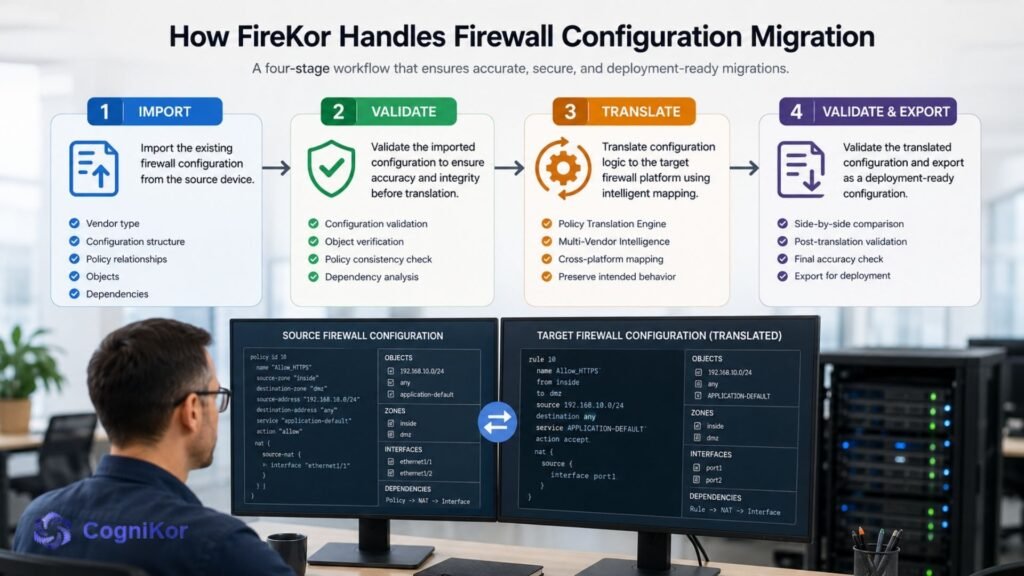
FireKor includes validation within the workflow so teams can verify configuration accuracy before deployment preparation progresses. This helps establish a cleaner, more controlled migration process.
3. Translate Configuration Logic
Translation is where cross-vendor migrations become particularly challenging. FireKor’s Policy Translation Engine is designed to understand firewall logic rather than simply replacing one vendor’s commands with another vendor’s syntax.
It can translate configurations into the target vendor’s structure while working to preserve the intended behavior.
FireKor also provides Multi-Vendor Firewall Intelligence, allowing the system to recognize firewall platforms and apply mapping based on vendor-specific capabilities and configuration structures.
4. Validate and Export
Translation should not be the final step. FireKor allows teams to review configurations through side-by-side comparison and perform validation before exporting the result.
The final output can then be prepared as a deployment-ready configuration for the destination environment.
Dynamic Dependency Handling During Migration
Firewall migrations do not always remain static from beginning to end.
Requirements may change, configurations may need adjustment, or dependencies may be affected as engineers refine the target environment.
FireKor’s Kinetic Migration Processing dynamically recalculates dependencies and translation logic when configurations are modified.
This can make migration workflows more adaptable than processes built around repeated manual translation.
Cross-Platform Policy Mapping
One of the greatest difficulties in vendor migration is that firewall platforms do not necessarily represent policies in identical ways.
FireKor provides Cross-Platform Policy Mapping to translate configurations while maintaining their logical integrity.
Rather than asking engineers to manually reconstruct every equivalent rule, the platform helps establish mappings between the source configuration and the destination environment.
This is particularly useful for organizations moving away from legacy infrastructure or standardizing networks around a new firewall platform.
Validation Should Be Part of the Migration
A translated configuration should be reviewed before production deployment. Industry firewall migration guidance emphasizes preparation, configuration verification, testing, and post-migration checks because migration errors can affect connectivity and security.
FireKor incorporates validation directly into its migration workflow.
Its validation capabilities support:
- Pre-migration checks
- Post-translation checks
- Configuration verification
- Side-by-side review
- Identification of migration warnings
- Review before configuration export
The objective is to make validation a defined stage rather than an afterthought.
Migration Reporting and Visibility
Large firewall migrations can involve hundreds or thousands of configuration elements.
Teams therefore need a clear record of what was translated and where potential issues require attention.
FireKor’s Audit & Reporting Engine generates detailed migration reports that can include:
- Configuration mappings
- Migration warnings
- Translation details
- Optimization recommendations
This provides teams with clearer visibility into the migration process and gives engineers useful information for review.
Firewall Migration at Enterprise Scale
Migrating one firewall is different from transitioning a large environment containing numerous devices or sites.
As the environment expands, manual migration effort can increase significantly.
FireKor includes enterprise-oriented capabilities such as:
- Elastic Scaling
- Project Templates
- Global Configuration Search
- Cross-Platform Policy Mapping
- Dynamic Port Hierarchy
- Multi-Vendor Firewall Intelligence
Project Templates can help teams use predefined network models to support more standardized deployments.
Global Configuration Search also helps locate relevant ports, VLANs, or devices across multiple sites, making complex environments easier to navigate during migration work.
Common Firewall Migration Challenges and the FireKor Approach
| Firewall Migration Challenge | FireKor Capability | Practical Benefit |
| Different vendor syntax | Policy Translation Engine | Reduces manual syntax conversion |
| Complex policy relationships | Logic-aware translation | Helps preserve intended behavior |
| Changing dependencies | Kinetic Migration Processing | Recalculates migration dependencies |
| Multi-vendor environments | Multi-Vendor Firewall Intelligence | Applies vendor-specific mapping |
| NAT and VPN migration | Intelligent configuration translation | Simplifies complex configuration transfer |
| Large environments | Elastic Scaling | Supports enterprise migration requirements |
| Migration verification | Validation engines | Adds structured checks |
| Configuration review | Side-by-side comparison | Makes translated output easier to verify |
| Migration documentation | Audit & Reporting Engine | Provides mappings and warnings |
| Deployment preparation | Validation & Export | Produces deployment-ready configurations |
FireKor: From Legacy Configuration to Deployment-Ready Firewall
The strongest migration process is not necessarily the one that copies configurations fastest.
It is the one that understands what must be preserved.
FireKor is designed around that idea.
Its workflow transforms an existing firewall configuration through four structured stages:
Import → Validate → Translate → Validation & Export
Instead of relying entirely on manual cross-vendor rule conversion, teams can use intelligent policy translation to preserve configuration logic while adapting it to the destination platform.
For enterprises dealing with complex policies, NAT rules, VPN configurations, multiple vendors, and large environments, this provides a more scalable approach to firewall migration.
FAQ’s
How does FireKor simplify firewall configuration migration?
FireKor provides a structured workflow built around Import, Validate, Translate, and Validation & Export.
Its capabilities include intelligent policy translation, multi-vendor firewall intelligence, cross-platform policy mapping, dynamic dependency processing, validation, detailed reporting, and deployment-ready configuration export.
What is policy translation in firewall migration?
Policy translation converts security policies from the structure used by the source firewall into a format appropriate for the destination firewall.
Rather than focusing only on syntax, FireKor’s Policy Translation Engine is designed to understand firewall logic and preserve the intended behavior when translating policies between platforms.
How should a firewall configuration be validated before deployment?
Teams should compare the source and translated configurations and verify important areas such as firewall policies, network objects, NAT rules, VPN configurations, interfaces, zones, and dependencies.
FireKor incorporates validation and side-by-side configuration review into the migration workflow, helping teams review translated configurations before export and deployment.
Can FireKor support complex enterprise firewall migrations?
FireKor is designed with enterprise migration requirements in mind. Features such as Elastic Scaling, Project Templates, Global Configuration Search, and Multi-Vendor Firewall
Intelligence help support larger and more complex environments. These capabilities are particularly useful when migrations involve multiple devices, locations, firewall platforms, or extensive configuration sets.
Why use FireKor instead of relying entirely on manual firewall migration?
Manual firewall migration can require engineers to interpret, translate, rebuild, and verify large numbers of policies and configuration elements individually.
FireKor helps automate repetitive translation work while providing policy intelligence, dependency handling, cross-platform mapping, validation, reporting, and deployment-ready exports. This allows engineering teams to focus more of their effort on reviewing and approving the migration.
Conclusion
A successful firewall configuration migration requires more than moving rules from one device to another. Policies, dependencies, NAT configurations, VPN settings, vendor differences, and security intent all need to be considered.
Traditional migration methods place much of this translation work on network and security engineers. As environments become larger and more complex, that process can become increasingly demanding. FireKor by CogniKor provides an intelligent alternative.
Through policy translation, multi-vendor intelligence, dynamic dependency processing, cross-platform mapping, validation, reporting, and deployment-ready exports, FireKor creates a structured path from legacy firewall configurations to modern target platforms.
Organizations planning a firewall transition can use FireKor to make configuration migration more consistent, scalable, and efficient while keeping the original security intent at the center of the process. Explore FireKor by CogniKor to discover a smarter approach to firewall configuration migration.