Overly permissive firewall rules expose your network to attacks. Learn how to identify, fix, and prevent excessive permissions that weaken security. Complete guide inside.
Introduction
Identifying overly permissive firewall rules requires significantly more than simply examining system activity. Scope creep, accumulated legacy permissions, platform-specific syntax differences, traffic pattern analysis, and uncontrolled configuration expansion each impact how efficiently your security team finds dangerous access grants.
For infrastructure teams managing several firewall devices, conducting a thorough examination becomes increasingly difficult as networks expand. Permissions pile up gradually without removal.
Old access authorizations remain active indefinitely. Finding exactly which permissions create gaps becomes nearly impossible without both intelligent detection and continuous monitoring.
This resource examines how CogniFire and FireKor work to find and remove excessive permission grants in distinct operational situations, plus what separates successful permission identification from outdated manual verification methods that overlook serious weaknesses.
Explore comprehensive protection solutions at CogniKor for your infrastructure security needs.
Overly Permissive Firewall Rules
Definition
Overly permissive firewall rules weaken an organization’s security posture by opening the door to access that security policies were supposed to block. When access control rules are too open, traffic can reach systems that were meant to stay separated.
Common Examples
A common example is an any-any firewall rule that allows traffic from any source to any destination across all ports. This includes rules that allow traffic from any source (0.0.0.0/0), open dangerous ports, permit protocols beyond requirements, or grant access to administrative interfaces from the internet.
How They Develop?
Overly permissive firewall rules often start as quick fixes, like temporary access added during troubleshooting or urgent deployments. Over time, those permissions remain in place, allowing far more connectivity between systems than intended.
Security Impact
Overly permissive rules violate least-privilege principles and expand the attack surface. Obsolete firewall rules expand attack surface, weaken segmentation, and complicate troubleshooting long after their original purpose disappears.
Scale of Problem
Permissive rules are those that allow “any-any” or overly broad access, and are one of the most common security gaps in firewall configurations. What starts as a simple security setup can quickly turn into hundreds or even thousands of rules.
Permission Grant Solutions Overview
| Platform | Ideal Situation | Identification Approach | Firewall Types | Speed to Deployment | Primary Advantage |
| CogniFire | Active systems requiring immediate inspection | Behavioral analysis using traffic inspection | Supports multiple brands | Minutes after setup | Identifies issues in active networks instantly |
| FireKor | Equipment replacement initiatives | Configuration audit alongside vendor transition | Multiple brand support | Corresponds to upgrade schedule | Establishes improved permissions during transition |
Each solution excels in distinct situations depending on your operational requirements.
Immediate Monitoring: CogniFire

CogniFire functions as an intelligent observation layer discovering excessive permissions, and initiating correction procedures without creating service interruptions.
Imagine having a permanent security specialist embedded in your network infrastructure who continuously examines every permission rule, understands its business justification, and alerts you the moment something grants too much access.
By examining which systems actually communicate through your firewalls, CogniFire learns whether existing permissions match actual operational needs. The system identifies guidelines that remain in place despite zero recent usage.
It discovers regulations that were written broadly for troubleshooting purposes and never tightened afterward. CogniFire manages multiple equipment manufacturers simultaneously, delivering consistent oversight regardless of your infrastructure diversity.
Capabilities that detect excessive permissions:
- Semantic Permission Analyzer – Grasps underlying business objectives rather than merely interpreting rule syntax
- Behavioral Monitoring System – Tracks genuine communication patterns to identify superfluous access levels
- Automated Interface Alignment – Ensures regulations apply to appropriate network zones and link points
- Standards Adherence Verification – Confirms regulations meet external mandates and internal governance
- Cross-Manufacturer Administration – Handles mixed infrastructure setups efficiently
- Unified Search Functionality – Discovers problematic regulations instantaneously across enormous rulesets
Advantages
- Systematic hardening eliminates repetitive manual operations
- Continuous analytics demonstrate specific vulnerabilities with precision
- Supports organizations running dissimilar equipment producers
Limitations
- Requires connection with current security infrastructure
- Maximum effectiveness depends on availability of detectable traffic patterns
For organizations supporting active firewall deployments, visit CogniFire at CogniKor for implementation details and technical specifications.
Upgrade-Time Hardening: FireKor
FireKor functions as a migration framework that transitions policies across firewall manufacturers while simultaneously examining and eliminating excessive permissions embedded in aging installations.
When moving equipment from older infrastructure to contemporary systems, FireKor becomes your opportunity to eliminate years of permission accumulation.
Throughout infrastructure modernization, most organizations discover their established equipment holds numerous excessive permission grants that went unremoved.
FireKor’s translation system comprehends the reasoning embedded in regulations, identifies problematic permission levels during translation, and generates a streamlined permission framework in your upgraded installation.
The framework functions across manufacturers, enabling transitions from any manufacturer to any other manufacturer. Equipment changeover happens without service disruption—no exposure windows during changeover operations.
Capabilities that enhance permission security:
- Intelligent Translation Module – Recognizes regulatory intent beyond simple format conversion
- Permission Scope Examination – Identifies excessive grants before new infrastructure receives them
- Accuracy Confirmation Framework – Validates permissions and identifies anomalies throughout deployment
- Manufacturer Translation Comparison – Displays permission variations that might be concealed within previous syntax
- Migration Documentation – Produces thorough reports displaying which regulations required correction
- Network Classification System – Categorizes access patterns and highlights inconsistencies
- Configuration Reference Sets – Supplies pre-built guidelines following established security frameworks
- Managed Changeover – Transitions systems while applying hardening systematically
Advantages
- Combines necessary equipment work with security strengthening
- Demonstrates readiness to improve protection during upgrade work
- Infrastructure launch includes superior permission configuration
- Seamless equipment transition maintains service availability
Limitations
- Valuable only during genuine equipment replacement initiatives
- Effectiveness relies on comprehensive pre-transition configuration evaluation
For infrastructure teams upgrading equipment, FireKor transforms the upgrade process into a security enhancement window.
Visit FireKor at CogniKor for migration specifics and validation procedures.
Detailed Comparison: CogniFire Versus FireKor
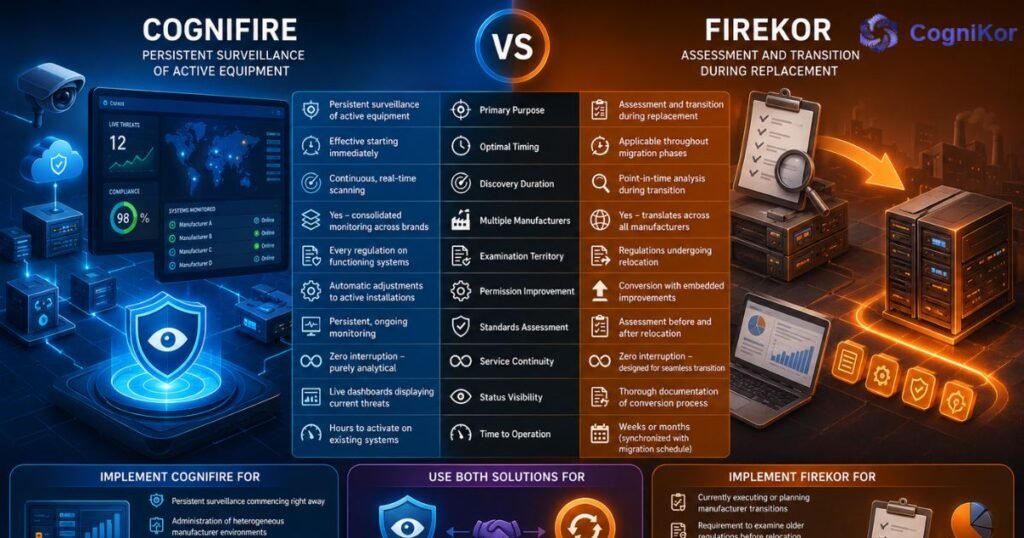
Comprehensive Feature Matrix
| Component | CogniFire | FireKor |
| Primary Purpose | Auto configuration of firewall through AI | Assessment and transition during replacement |
| Optimal Timing | Effective starting immediately | Applicable throughout migration phases |
| Discovery Duration | Continuous, real-time scanning | Point-in-time analysis during transition |
| Multiple Manufacturers | Yes – consolidated monitoring across brands | Yes – translates across all manufacturers |
| Examination Territory | Every regulation on functioning systems | Regulations undergoing relocation |
| Permission Improvement | Automatic adjustments to active installations | Conversion with embedded improvements |
| Standards Assessment | Persistent, ongoing monitoring | Assessment before and after relocation |
| Service Continuity | Zero interruption – purely analytical | Zero interruption – designed for seamless transition |
| Status Visibility | Live dashboards displaying current threats | Thorough documentation of conversion process |
| Time to Operation | Hours to activate on existing systems | Synchronized new setup in minutes |
Selecting the Right Solution
Implement CogniFire for:
- Administration of heterogeneous manufacturer environments
- Desire for autonomous improvement processes
- Upcoming infrastructure overhaul not scheduled soon
- Requirement for immediate visibility into vulnerability levels
Implement FireKor for:
- Currently executing or planning manufacturer transitions
- Requirement to examine older regulations before relocation
- Comprehensive pre- and post-transition validation needs
- Concurrent infrastructure modernization programs
- Ability to coordinate examination with planned downtime
- Objective to establish hardened baseline in new systems
Use Both Solutions for:
- Transitioning between manufacturers (use FireKor during changeover)
- Long-term protection of new infrastructure (deploy CogniFire following transition)
Understanding Excessive Permission Grants
A regulation grants excessive permissions when it allows broader access than the actual operational requirement necessitates. Instead of authorizing communication from one specific server to another specific server on designated communication channels, an excessive grant might permit “any origin to any endpoint on all communication types.”
Typical scenarios:
- “Permit everything to everything” regulations inserted temporarily during troubleshooting sessions
- Guidelines enabling entire network sections when singular devices require access
- Communication pathways remaining active for discontinued system versions
- Third-party access authorizations that expanded but were never limited
- Testing guidelines that entered production systems unintentionally
Reason for concern:
Attackers specifically hunt for these situations. Upon gaining initial network access, an excessive permission guideline provides a pathway to move between systems, find confidential records, and obtain elevated permissions.
A solitary excessive rule can convert a limited security incident into a serious information compromise.
Most organizations first become aware of excessive permissions after security incidents; once harm has occurred.
How Do These Solutions Address the Problem?
CogniFire’s Continuous Intelligence Model
CogniFire functions similarly to an artificial intelligence analyst who operates continuously without rest. It systematically:
- Observes data moving through your equipment
- Examines which regulations truly function
- Suggests modifications for tighter limitations
- Implements improvement when authorized
Since it watches genuine data patterns, CogniFire determines which regulations serve genuine purposes and which sit dormant.
It discovers regulations with zero matching activity for extended durations (presumably obsolete). It identifies regulations with surprising communication patterns (potentially misconfigured).
Illustration: A regulation authorizes communication protocol 3306 from network section 10.0.0.0/16 to one particular server. CogniFire examines data and determines that merely four distinct networked devices ever utilize this pathway.
FireKor’s Transition-Moment Analysis
FireKor identifies excessive permissions when you’re already changing equipment. Transitioning regulations from aged equipment to contemporary equipment, it:
- Retrieves the aged setup
- Evaluates which regulations grant excessive permissions
- Alerts to problematic patterns before translation
- Converts regulations properly while implementing improvements
- Confirms the contemporary setup matches your intentions
Since it translates regulation-by-regulation, FireKor identifies reasoning that appears acceptable in aged language but looks improper in contemporary language. It additionally benchmarks your regulations against protection frameworks and highlights departures.
Illustration: Your aged manufacturer configuration contains “Permit everything to everything.” Transitioning to contemporary equipment, FireKor alerts to this, researches genuine communication requirements, and generates targeted regulations for each legitimate communication need. Your contemporary installation launches with superior permission configuration.
FAQ’s
An excessive regulation permits more access than originally intended (yet functions as composed). A misconfigured regulation doesn’t function as originally intended. Both create difficulties, yet excessive regulations hide successfully. They function perfectly—they simply function excessively.
Investigation indicates roughly fifteen to forty percent of active regulations are either disused or excessively permissive. Within a ten-thousand-regulation setting, that represents fifteen-hundred to forty-hundred problematic regulations.
A security information system displays which data communication happens, yet it doesn’t determine if regulations should permit that width. You still require intelligence to make that judgment. CogniFire merges communication evaluation with artificial intelligence to make that determination.
Programs cease functioning. Individuals express frustration. This explains why improvement proceeds progressively and testing precedes widespread implementation. Both solutions allow you to confirm improvements before general rollout.
Not necessarily. Both systems are constructed for independent operation. CogniKor supplies guidance and assistance.
Conclusion
Overly permissive firewall rules can create serious security gaps by allowing more traffic than an organization actually needs. While broad rules may simplify network management, they can increase the risk of unauthorized access, lateral movement, and data exposure. Regular firewall rule reviews, least privilege policies, proper segmentation, and continuous monitoring can help reduce these risks. By identifying and tightening overly permissive rules, organizations can maintain stronger security without disrupting legitimate business traffic.