Automate firewall compliance audits with AI powered assessments, risk detection, security baselines, and continuous compliance monitoring for stronger network security.
Introduction
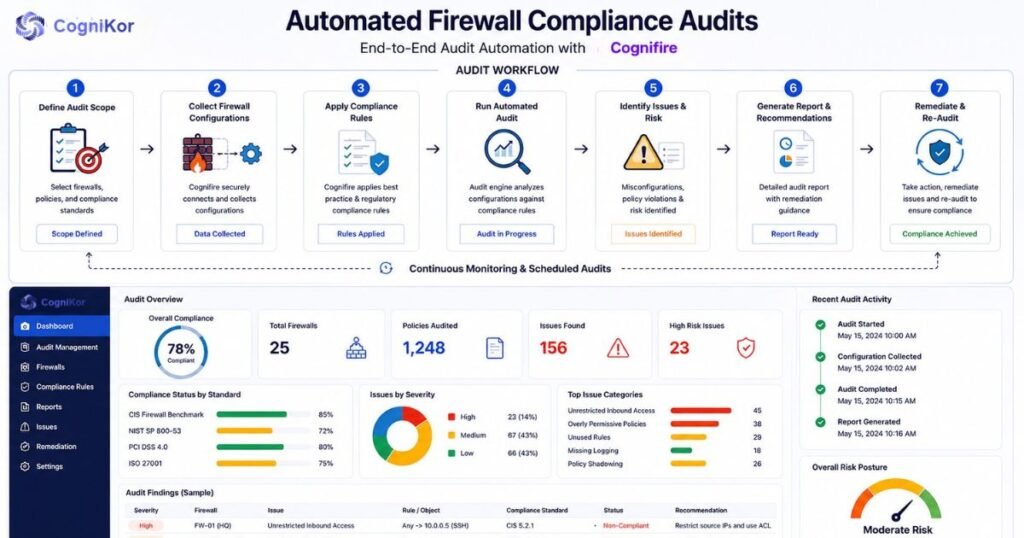
Firewall compliance audits are essential for ensuring that security policies, configurations, and access rules meet required standards. However, manually reviewing large and complex firewall environments can be time consuming and prone to human error. Automated Firewall Compliance Audits use intelligent tools to continuously assess firewall configurations, identify security gaps, detect policy violations, and compare settings against defined security and compliance requirements.
This approach gives security teams better visibility into their firewall environment while reducing the effort required for routine audits. With automated assessment and real time risk analysis, organizations can identify potential issues faster and take corrective action before they become serious security risks.
What Are Compliance Audits and Why They Matter?
Compliance audits involve continuously monitoring firewall rules against established compliance frameworks and generating real-time alerts for any non-compliant or risky rule changes, while also producing automated reports for internal teams and external auditors.
Organizations operating under regulatory frameworks like PCI-DSS, HIPAA, and NIST require systems that can validate firewall configurations meet industry standards. Manual auditing has become impractical what once took weeks of effort can now be completed in minutes with the right automation tools.
The Challenge of Manual Firewall Management
Maintaining firewall compliance manually is error-prone and resource-intensive. Security teams struggle with managing thousands of rules across multiple platforms, documenting changes, and proving compliance during audit periods. This is where intelligent automation becomes essential.
Cognifire: AI-Powered Firewall Intelligence for Compliance
At Cognikor, we developed Cognifire to solve this exact problem. Cognifire is an AI-driven firewall automation platform that transforms how organizations handle security configuration and policy management.
- Cognifire’s Policy Intelligence Engine works by understanding your security intentions and converting them into optimized firewall rules aligned with industry best practices.
Rather than simply accepting whatever rules are created, the system analyzes the underlying intent and ensures configurations are structured logically and efficiently. This approach is critical for compliance because auditors need to understand not just what rules exist, but why they exist.
- The Kinetic Rule Optimization feature continuously evaluates your firewall rules based on actual traffic behavior. The platform identifies redundant rules, overlapping policies, and misconfigurations that could violate compliance standards.
When the system detects a rule that doesn’t align with your organization’s compliance requirements, it provides detailed recommendations for remediation. This real-time optimization means your firewall remains compliant even as your network evolves.
- One of Cognifire’s standout capabilities is its Multi-Vendor Firewall Intelligence. Most organizations don’t have a single firewall brand they have Palo Alto Networks, Fortinet, Cisco, Check Point, and others running simultaneously. Cognifire uses RAG-based knowledge retrieval to accurately understand and manage policies across all these different platforms from a unified interface.
This eliminates the compliance gaps that typically exist when teams manage multiple firewalls separately.
- For compliance documentation, Cognifire provides Real-Time Risk Analysis that continuously evaluates vulnerabilities and configuration gaps against your security requirements.
The Compliance Overlay feature ensures every configuration automatically aligns with relevant regulatory standards. When an auditor asks “prove that your firewall meets PCI-DSS requirements,” you can generate this evidence instantly rather than scrambling to collect logs and documentation.
The platform’s Dynamic Policy Hierarchy structures complex rule sets into logical layers that auditors can easily understand and verify. The One-Click Hardening capability lets you apply security best practices across all your firewalls instantly, ensuring compliance consistency across your entire network.
| Firewall Issue / Problem | What CogniFire Does | Result |
| Redundant Firewall Rules | Continuously analyzes and refines firewall rules based on live traffic | Removes unnecessary rules and improves performance |
| Poor Rule Structure | Uses Dynamic Policy Hierarchy to organize complex rule sets | Better visibility and governance |
| Security Misconfigurations | Performs real time risk analysis to identify vulnerabilities and threats | Helps detect security risks faster |
| Weak Security Settings | Applies security best practices through One Click Hardening | Strengthens firewall security |
| Incorrect Interface or Zone Mapping | Uses Smart Rule Mapping to align policies with the correct interfaces and zones | Reduces policy configuration errors |
| Non Compliant Configurations | Uses a Compliance Overlay to align configurations with regulatory and internal standards | Improves compliance posture |
| Unoptimized Firewall Policies | Converts security intent into optimized firewall configurations | Creates more effective security policies |
| Complex Multi Vendor Environments | Provides Multi Vendor Firewall Intelligence | Helps manage policies across different firewall platforms |
| Unprotected Critical Network Zones | Uses Threat Boundary Logic for logical network segmentation | Helps isolate and protect critical areas |
| Difficult Rule Searching | Global Policy Search locates rules and configurations across systems | Faster policy investigation |
| Outdated or Weak Security Baselines | Provides predefined Security Baselines | Makes secure configuration deployment easier |
| Firewall Configuration Risks | Assesses current rules and identifies risks | Gives teams better visibility before changes are deployed |
| Manual Firewall Configuration | Automates configuration deployment | Reduces manual effort and configuration errors |
| Changing Security Threats | Continuously monitors and adapts to threats | Supports ongoing protection |
Learn more about Cognifire’s compliance capabilities: https://cognikor.com/products/cognifire/
FireKor: Enterprise Firewall Migration with Built-In Compliance Validation
FireKor, Cognikor’s second flagship solution, addresses a specific but critical compliance challenge: migrating between firewall platforms while maintaining policy integrity and audit trails.
- When organizations upgrade or consolidate firewalls, compliance becomes exceptionally complex. Rules must be translated accurately, configurations validated before deployment, and every change documented for audit purposes. FireKor was built to handle this precisely.
- FireKor’s Policy Translation Engine doesn’t just convert syntax it understands the logical intent behind each rule. When translating rules from a legacy Cisco firewall to a Palo Alto deployment, the system ensures behavioral equivalence. This is crucial for compliance because regulators need assurance that security posture doesn’t degrade during migration.
- FireKor preserves the intent of original policies while adapting them to the target platform’s capabilities.
- The platform’s Kinetic Migration Processing dynamically recalculates dependencies and translation logic in real time as configurations are modified. This prevents the situation where one rule change inadvertently creates a compliance gap elsewhere in the configuration. Every change is automatically validated against your compliance requirements before it’s applied.
- FireKor includes an Audit & Reporting Engine that generates detailed migration reports documenting exactly which policies were translated, how they were mapped, and what optimization recommendations were applied. These reports become invaluable during compliance audits because they provide auditors with complete visibility into the migration process.
- The Real-Time Validation Engine continuously verifies configurations before and after deployment, catching compliance issues before they affect your production environment.
- For organizations with multiple sites, FireKor’s Global Configuration Search lets you instantly locate policies, rules, or configurations across your entire infrastructure. This capability is essential when auditors ask to see all rules that access a particular system or application.
The Validation Overlay Engine performs both pre- and post-migration checks, ensuring accuracy throughout the transition. Organizations can use FireKor’s Project Templates based on network models that already comply with your regulatory requirements, significantly accelerating the deployment of compliant configurations.
| Firewall Migration Problem | What FireKor Does | Result |
| Complex Firewall Migration | Automates the migration of firewall configurations between vendors | Faster and more efficient migration |
| Manual Rule Conversion | Translates existing firewall policies into the format required by the target firewall | Reduces manual configuration work |
| Different Vendor Syntax | Converts firewall rules between different vendor environments | Helps maintain policy consistency |
| VPN Migration Challenges | Migrates and translates VPN configurations and policies | Simplifies VPN migration |
| Configuration Compatibility Issues | Analyzes existing configurations before migration | Helps identify potential migration problems |
| Policy Translation Errors | Converts complex security policies for the target platform | Reduces the risk of manual translation errors |
| Large Rule Sets | Handles complex firewall policy environments during migration | Makes large scale migrations easier |
| Migration Validation | Validates migrated configurations and policies | Helps ensure the target firewall is configured correctly |
| Business Disruption During Migration | Supports streamlined migration workflows | Helps reduce migration downtime |
| Multi Vendor Firewall Environments | Supports firewall migration across different vendor platforms | Simplifies vendor transition |
| Legacy Firewall Replacement | Helps move existing firewall configurations to newer platforms | Makes firewall modernization easier |
| Manual Migration Effort | Automates repetitive migration and conversion tasks | Saves time and resources |
Explore FireKor’s migration and compliance features: https://cognikor.com/products/firekor/
How Cognikor Addresses the Full Lifecycle of Firewall Compliance
Cognikor’s solutions work together to address compliance at every stage. Cognifire handles day-to-day compliance through continuous monitoring and optimization, ensuring your existing firewalls remain compliant as your network evolves. When major changes occur platform migrations, infrastructure consolidation, or regulatory requirement updates FireKor ensures transitions happen without compliance degradation.
Both products provide the documentation, evidence, and audit trails that regulators demand. Instead of manually collecting logs and evidence during audit periods, your team has continuous compliance proof available instantly.
The Cost Efficiency advantage is substantial. Organizations that implement Cognifire and FireKor typically reduce compliance audit preparation time by 80% or more. This frees your security team from reactive firefighting to focus on strategic security initiatives.
FAQ’s
Yes. Automated audits can help compare firewall configurations with applicable security standards, organizational policies, and regulatory requirements. The exact frameworks supported depend on the auditing solution.
No. Automation reduces repetitive auditing and analysis work, but security professionals are still needed to review findings, determine business impact, approve changes, and handle complex security decisions.
Some platforms can go beyond identifying issues and provide remediation capabilities. For example, automation can help optimize rules, apply security hardening, or bring configurations closer to defined security baselines.
A manual audit relies heavily on security professionals reviewing configurations and policies themselves. An automated audit uses software to analyze configurations much faster and can support continuous monitoring, risk detection, and repeatable compliance checks.
AI can analyze complex firewall policies, identify potential risks, understand relationships between rules, and help security teams prioritize issues. AI driven solutions can also support policy optimization, security hardening, and faster remediation.
Conclusion
Automated Firewall Compliance Audits provide a faster and more consistent way to assess firewall security, identify misconfigurations, detect policy risks, and maintain compliance requirements. Instead of relying entirely on time consuming manual reviews, organizations can use automation to continuously assess firewall configurations and identify issues before they become serious security problems.
Solutions such as CogniFire can further support this process through risk analysis, security baselines, compliance alignment, and automated firewall hardening. As firewall environments become more complex, automated auditing can help security teams improve visibility, reduce manual effort, and maintain a stronger and more reliable security posture.