Firewall Policy Change Management best practices guide. Learn how to automate policies, ensure compliance, and reduce security risks. Explore Cognifire and Firekor solutions.
Introduction
Organizations face unprecedented challenges in managing firewall policies across complex, heterogeneous network environments. Network teams struggle to balance security requirements with operational agility, and firewall policy management remains one of the most critical yet often overlooked components of enterprise security.
Every policy change introduces risk, requires careful validation, and demands meticulous documentation. The stakes grow higher as businesses expand their infrastructure across multiple vendors, cloud platforms, and geographically distributed locations.
This article explores the critical aspects of firewall policy change management, the challenges organizations encounter, and how modern AI-driven solutions transform traditional approaches into intelligent, automated operations.
The Critical Role of Firewall Policy Management
Firewall policies form the foundation of network security. These policies determine which traffic flows through the network, which connections organizations block, and how the organization applies security controls to different network segments. When firewall policies contain errors or become outdated, organizations expose critical assets to unauthorized access or inadvertently block legitimate business traffic.
Traditional firewall policy management relies heavily on manual processes. Network administrators receive change requests, manually create or modify rules, test configurations, and deploy changes across infrastructure. This approach demands significant expertise, consumes considerable time, and introduces human error at every step. Organizations that manage multiple firewall platforms, whether Palo Alto Networks, Cisco ASA, Fortinet FortiGate, or others, face exponentially greater complexity. Administrators must translate security intent across different vendor syntaxes, rule structures, and behavioral models.
The consequences of poorly managed firewall policies extend beyond technical concerns. Organizations experience increased security incidents due to overly permissive rules, operational disruptions from accidentally blocked traffic, compliance violations from inadequate policy documentation, and significant IT staff burnout from repetitive manual work.
Understanding Firewall Policy Change Management
Firewall policy change management encompasses the entire lifecycle of creating, implementing, monitoring, and retiring firewall rules. Effective change management requires organizations to:
- Document Security Intent: Organizations must clearly articulate why policies exist, which business functions they support, and which threats they mitigate. This documentation becomes critical during policy reviews, security audits, and troubleshooting efforts.
- Implement Standardized Processes: Standardization reduces errors and ensures consistent security posture. Organizations establish naming conventions, rule hierarchies, testing procedures, and approval workflows that create predictability and reduce confusion.
- Maintain Visibility Across Infrastructure: As networks grow, administrators lose visibility into global policy configurations. Rules proliferate across multiple firewalls, and redundant or contradictory policies emerge. Organizations need tools that instantly locate rules, identify duplicates, and surface policy conflicts.
- Validate Changes Before Deployment: Even minor syntax errors in firewall configurations can trigger outages or create security gaps. Organizations must implement rigorous validation procedures that catch mistakes before they reach production environments.
- Ensure Compliance and Auditability: Regulatory requirements demand detailed records of policy changes, including who made changes, when changes occurred, what changed, and why changes were necessary. Organizations must generate audit trails that satisfy compliance frameworks like SOC 2, ISO 27001, and industry-specific regulations.
Common Challenges in Firewall Policy Management
Network teams encounter several recurring obstacles when managing firewall policies:
Multi-Vendor Complexity: Organizations rarely standardize on a single firewall vendor. The average enterprise manages policies across Palo Alto Networks, Cisco, Fortinet, Check Point, and other platforms simultaneously. Each platform uses different rule syntax, different configuration methodologies, and different optimization approaches. Administrators must maintain expertise across multiple systems and manually translate policies between platforms a process prone to errors and inconsistencies.
- Policy Sprawl and Redundancy: Firewall policies accumulate over time. New rules get added continuously, but old rules rarely get removed. This creates rule bloat where hundreds or thousands of rules exist within a single firewall. Redundant rules accumulate, rules conflict with other rules, and administrators lose track of why specific rules exist. Rule bloat degrades firewall performance and makes troubleshooting exponentially more difficult.
- Knowledge Loss and Documentation Gaps: When experienced administrators leave organizations, critical knowledge about firewall policies walks out the door. Policies lack comprehensive documentation explaining business purpose, dependencies, and optimization rationale. New team members struggle to understand existing policies or confidently make changes without risking outages.
- Change Risk and Validation Complexity: Firewall changes introduce operational risk. Even experts occasionally introduce errors. Organizations need robust testing procedures, but comprehensive pre-production testing consumes enormous time and resources. Many organizations skip thorough testing to meet aggressive deployment timelines, rolling the dice with production systems.
- Compliance and Audit Requirements: Demonstrating compliance requires detailed documentation of policy creation, modification, and validation procedures. Organizations must prove that policies align with security standards, that changes follow approved processes, and that access controls prevent unauthorized modifications. Manual processes make compliance demonstrations difficult and time-consuming.
- Migration and Platform Transitions: When organizations migrate from one firewall platform to another, they must translate existing policies into new vendor syntax while preserving security intent. This process demands deep understanding of both source and target platforms. Even experienced teams spend months on major migrations, and migration errors frequently surface only after deployment.
Cognifire and Firekor: Integrated Solutions for Policy Excellence
CogniKor’s firewall automation platform combines complementary capabilities that address the complete spectrum of firewall policy challenges:
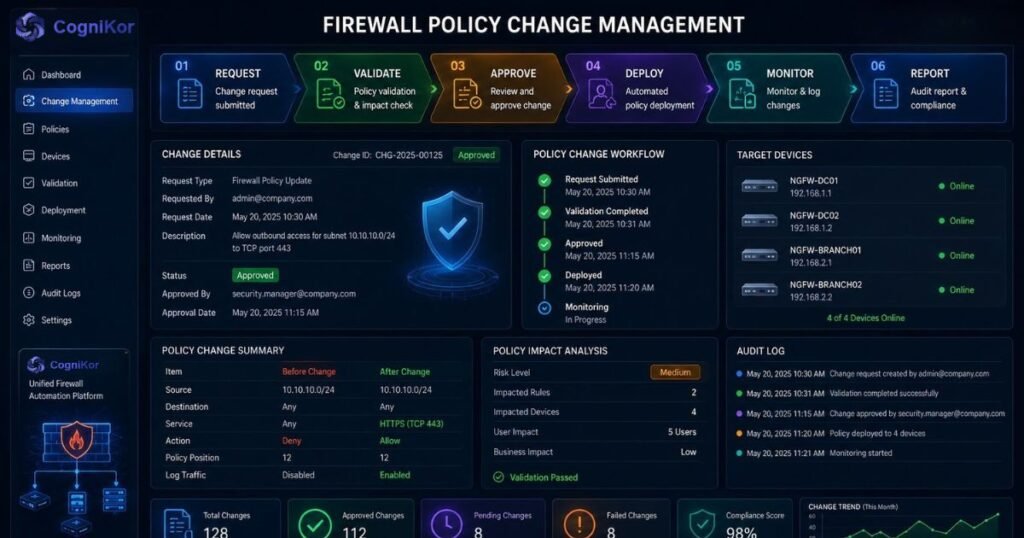
Cognifire transforms firewall management through intelligent policy automation. The platform’s Policy Intelligence Engine understands security intent and converts complex business requirements into optimized configurations. Kinetic Rule Optimization continuously refines rules based on live traffic analysis, eliminating redundancy while maintaining security posture.
The multi-vendor intelligence layer accurately maps policies across Palo Alto Networks, Cisco, Fortinet, and other platforms, enabling organizations to manage heterogeneous environments as unified systems. Dynamic policy hierarchy structures complex rule sets into logical, manageable layers. Real-time risk analysis continuously evaluates configurations against emerging threats and vulnerabilities. Compliance overlay ensures configurations meet regulatory and internal standards automatically.
Firekor specializes in firewall migration and policy translation. The platform’s Policy Translation Engine doesn’t merely convert syntax it understands security logic and preserves behavior across vendor platforms. Organizations avoid the months of manual work traditionally required for major firewall migrations. Kinetic Migration Processing dynamically recalculates dependencies as configurations change, ensuring consistency throughout migration processes.
The platform generates detailed audit and reporting documentation automatically, capturing every transformation and providing evidence for compliance audits. Real-time validation engines verify accuracy before and after deployment, eliminating deployment surprises and reducing post-migration troubleshooting.
Together, these solutions enable organizations to:
- Reduce operational complexity by automating routine policy management tasks
- Accelerate change velocity by eliminating manual bottlenecks that slow deployments
- Improve security posture by enabling best practice policies at scale
- Simplify compliance through automated documentation and validation
- Minimize risk by catching errors before production deployment
- Enhance team productivity by eliminating repetitive manual work
| Feature | Cognifire | Firekor |
| Primary Focus | Firewall policy automation and management | Firewall migration and policy translation |
| Core Engine | Policy Intelligence Engine | Policy Translation Engine |
| Key Capability 1 | Kinetic Rule Optimization | Kinetic Migration Processing |
| Key Capability 2 | Multi-vendor intelligence layer | Policy Translation with behavior preservation |
| Key Capability 3 | Dynamic policy hierarchy | Dependency recalculation |
| Supported Vendors | Palo Alto Networks, Cisco, Fortinet, and others | Cross-platform translation |
| Risk Analysis | Real-time risk evaluation against threats | Real-time validation engines |
| Compliance | Compliance overlay for standards | Automated audit and reporting documentation |
| Use Case | Ongoing policy management, optimization, and automation | Platform migrations and major transitions |
| Key Benefit | Reduces operational complexity, automates routine tasks | Eliminates manual conversion work, ensures accuracy |
Building Effective Firewall Policy Change Management
Organizations implementing modern firewall policy management systems follow established best practices:
- Establish Clear Governance: Define who requests policy changes, how changes get approved, and which team members can deploy production changes. Clear governance prevents unauthorized modifications and maintains audit trails required for compliance.
- Implement Structured Processes: Standardize naming conventions, rule documentation, testing procedures, and deployment workflows. Consistency reduces errors and enables knowledge sharing across teams.
- Invest in Visibility Tools: Deploy solutions that provide real-time visibility into global configurations. Visibility enables teams to prevent duplicate rules, identify policy conflicts, and understand dependencies.
- Prioritize Documentation: Maintain comprehensive documentation of policy purpose, business justification, and technical implementation. Documentation enables future teams to understand policies and confidently make changes.
- Automate Validation: Never rely on manual testing to catch configuration errors. Automated validation engines catch mistakes that humans miss and reduce deployment risk significantly.
- Plan for Migration: When transitioning firewall platforms, deploy solutions that translate policies intelligently. Avoid manual conversion processes that introduce errors and require excessive labor.
FAQ’s
Documentation should include the original change request, approval records, implementation details, and test results for each change. All modifications should be tracked with timestamps, responsible personnel, and business justification for audit and compliance purposes. Version control systems or change management tools should maintain a complete history of all firewall configurations. This documentation proves compliance and aids in troubleshooting future issues.
Popular tools include change management platforms like ServiceNow and Jira that track and approve changes systematically. Network management solutions like SolarWinds and Cisco provide centralized firewall management and monitoring capabilities. Version control systems like Git can track configuration changes over time with detailed commit histories. Many organizations also use custom scripts and automation tools to streamline deployment and reduce manual errors.
Organizations should conduct quarterly reviews as a minimum standard to identify unused rules and security gaps. However, policy reviews should also occur whenever significant business changes happen, such as new applications or organizational restructuring. Annual comprehensive audits are recommended to ensure compliance with security standards and regulations. More frequent reviews may be necessary for highly critical or regulated environments.
Standard changes follow the complete change management process with full approvals and testing, typically taking days or weeks for implementation. Emergency changes can bypass certain approval steps when critical security incidents or outages occur but still require documentation and post-implementation review. Emergency changes must be authorized by senior security staff and documented in change logs for later audit. Both types require approval, but emergency changes prioritize speed over process when business continuity is at risk.
Compliance is maintained by following your organization’s established change management policy consistently for every modification made. Maintain complete audit trails showing who authorized each change, when it was implemented, and what was changed in the configuration. Regular compliance audits should verify that all changes were properly approved and documented according to standards. Ensure your change process aligns with applicable regulations like SOC 2, ISO 27001, PCI DSS, or HIPAA requirements.
Conclusion
Firewall policy change management remains one of the most critical yet most underestimated components of modern security operations. Organizations that master this discipline gain significant competitive advantages. They deploy changes faster, maintain a stronger security posture, achieve compliance more efficiently, and enable security teams to focus on strategic initiatives rather than repetitive manual tasks.
By embracing AI-driven automation platforms that intelligently manage firewall policies across heterogeneous environments, organizations transform firewall management from a burden into a strategic advantage. The future belongs to organizations that automate routine policy management, enable data-driven security decisions, and continuously optimize configurations based on real-time analysis.
The journey toward intelligent firewall policy management begins with recognizing that traditional manual approaches no longer suffice for modern enterprises. Organizations ready to embrace automation, invest in visibility, and deploy intelligent solutions position themselves for security excellence in an increasingly complex threat landscape.