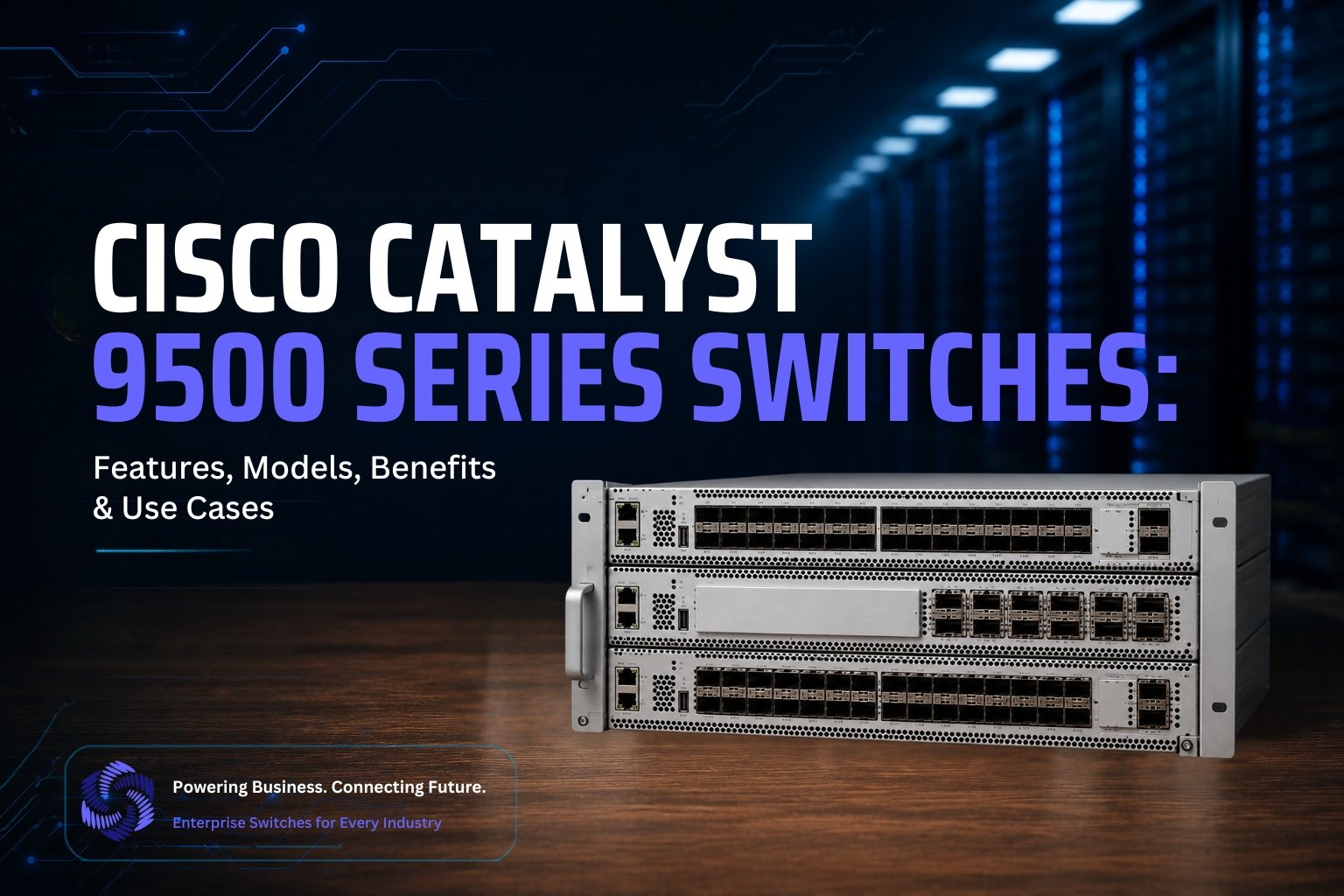
Discover Cisco Catalyst 9500 Series Switches with 10G, 25G, 40G, and 100G performance, advanced security, StackWise Virtual, and top models for enterprise networks.
Introduction
Cisco Catalyst 9500 Series Switches are built for organizations that need the core of the network to be fast, stable, and easy to run. Cisco positions the series as its leading fixed-core enterprise platform, with options that support modern campus design, high-density fiber, and advanced services for today’s hybrid workplaces.
In practical terms, this family is not just about moving traffic from one side of the network to the other. It is about giving IT teams a switch that can handle demanding workloads, support enterprise security, and fit into larger Cisco campus architectures without adding unnecessary complexity.
Key Features of Cisco Catalyst 9500 Series Switches
The Catalyst 9500 family combines high throughput, enterprise software, and strong security controls in a fixed-switch design. That balance is what makes it attractive for organizations that want serious performance without moving to a larger, more complex chassis architecture.
High-Speed 10G, 25G, 40G, and 100G Connectivity
The Cisco Catalyst 9500 family is designed for high-speed enterprise networking, with models that support a wide mix of uplink and fixed-port speeds. Cisco’s product page highlights high-density fiber models such as the C9500-24Y4C and C9500-32C, while the 9500X models extend the lineup even further with 100G, 200G, and 400G capabilities for campus core and distribution use cases. That flexibility makes the series suitable for environments where traffic keeps growing and the network has to keep up.
Advanced Layer 2 and Layer 3 Switching
Cisco builds the Catalyst 9500 series for serious campus routing and switching, not just basic packet forwarding. The datasheet shows support for advanced services such as MPLS Layer 2 and Layer 3 VPNs, MVPN, NAT, and VRF-aware LISP, which gives enterprises the tools to segment traffic and support complex routing designs. In a real network, that means the switch can do much more than connect devices; it can help organize the network itself.
Cisco IOS XE Operating System
The series runs Cisco IOS XE, which is a major advantage for teams that want enterprise control plus automation readiness. Cisco’s release notes describe the platform as running an open Cisco IOS XE that supports model-driven programmability, so it is built for both traditional CLI operations and modern infrastructure workflows. That makes it easier to integrate the switch into automation, telemetry, and centralized network operations.
StackWise Virtual Technology
StackWise Virtual is one of the most useful design features in the Catalyst 9500 family because it helps create a unified logical switch across two physical devices. Cisco includes this capability in the platform to improve resiliency and simplify the architecture of enterprise cores and distribution layers. For IT teams, it is like turning two separate boxes into one coordinated system, which can reduce operational friction and improve availability.
Enterprise-Grade Security Features
Security is built into the series rather than treated as an add-on. Cisco states that the Catalyst 9500 family includes security and insights built in, and the 9500X product overview specifically calls out advanced security capabilities such as MACsec-256 and Trustworthy Systems.
MACsec Encryption
MACsec helps protect traffic at the link layer, which is valuable in environments where sensitive data moves across campus and aggregation networks. Cisco identifies MACsec-256 as one of the advanced security capabilities in the 9500X family.
Secure Boot and Trustworthy Solutions
Cisco also highlights trustworthy systems and secure platform behavior. That matters because enterprise networks need confidence that the hardware and software foundation itself is protected, not just the traffic moving through it.
Benefits of Cisco Catalyst 9500 Series Switches
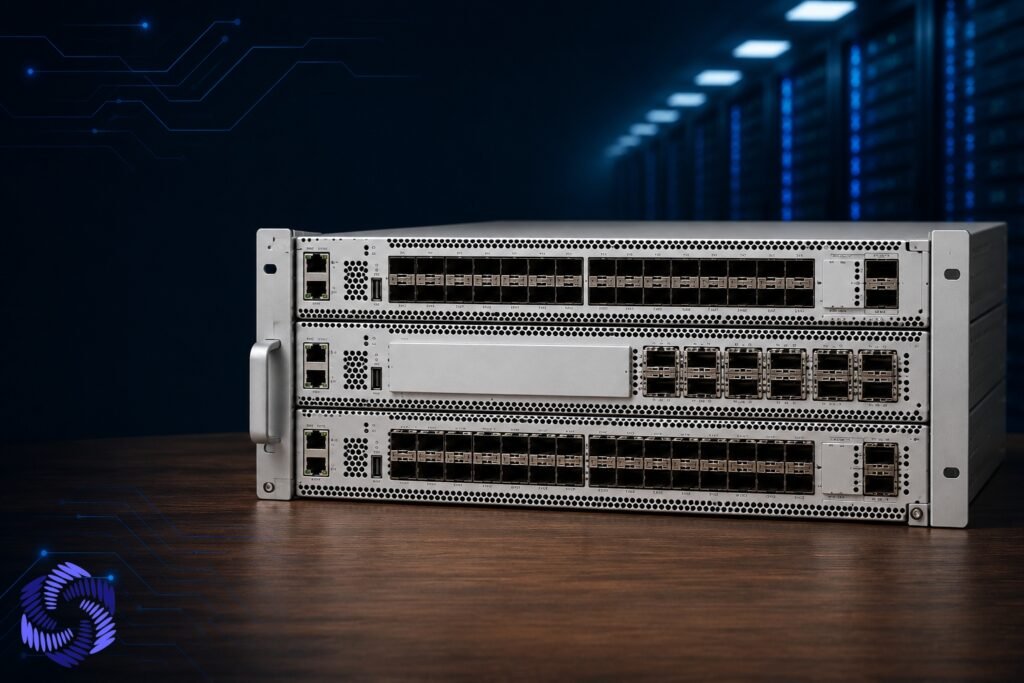
The biggest advantage of the Catalyst 9500 series is that it blends performance, reliability, and manageability in a way that fits large business networks. Cisco built the platform to support the realities of modern enterprise traffic, not the simpler networks of the past.
Exceptional Network Performance
These switches are designed for heavy traffic loads, high-speed fiber connections, and demanding enterprise workloads. The platform’s high-capacity architecture, especially in the 9500X line, gives organizations the performance headroom they need for growth.
High Availability and Reliability
Core switches must stay online. Cisco addresses this with redundant power supply support, modular fans, and StackWise Virtual options that improve resilience. The result is a platform built to reduce disruption and keep the network available.
Simplified Network Management
Cisco IOS XE, model-driven programmability, and logical virtual switch options make day-to-day management easier. That means fewer manual headaches and more consistent network operations across large environments.
Built for Future Growth
Cisco built the Catalyst 9500 series for modern enterprise demands, not yesterday’s traffic patterns. With high-speed port options, automation support, and scalable architecture, the series gives businesses room to expand without constantly redesigning the core.
Common Use Cases for Cisco Catalyst 9500 Series Switches
Cisco clearly frames the Catalyst 9500 family for enterprise core and aggregation use, but the platform also fits several real-world deployment scenarios. That flexibility is one reason it shows up in so many campus and backbone designs.
Enterprise Campus Core
This is the sweet spot for the series. The Catalyst 9500 is designed to sit at the center of the campus and handle large volumes of north-south and east-west traffic without becoming a bottleneck.
Distribution Layer Networks
Distribution layers need strong routing, fast forwarding, and enough flexibility to support multiple access segments. The 9500 series is well suited for that role because it offers both Layer 2 and Layer 3 capabilities plus strong uplink options.
Healthcare, Education, and Government Organizations
These environments often need resilient, policy-driven networks with strong security and predictable uptime. Cisco’s security, SD-Access, and high-availability features make the 9500 family a strong match for these sectors.
Large Business and Data Center Edge Deployments
Large offices and data center edge environments can also benefit from the family’s high-speed fiber support and advanced routing features. It is especially useful where multiple systems need to connect quickly and reliably to a central switching layer.
Cisco Catalyst 9500 and 9500X Models
Cisco offers different models so enterprises can match the switch to the workload instead of forcing one design into every scenario. The current lineup includes standard Catalyst 9500 models and higher-performance Catalyst 9500X models.
High-performance Catalyst 9500 models
These are the standard fixed enterprise models that still deliver strong core and aggregation performance. Cisco’s product page lists several common options with different port mixes and uplink patterns.
C9500-24Y4C
A high-density fiber model with 24-port 25G/10G/1G and 4-port 100G/40G support. Cisco positions it for campus distribution and high-speed environments.
C9500-40X
A strong fit where 10G-class connectivity is still central to the design. It is typically used where core and aggregation performance matters but the port profile is different from the denser fiber variants.
C9500-48Y4C
A higher-density option for enterprise networks that need more 25G/10G access on the switch itself along with 100G uplinks.
C9500-32C
A core-friendly option that suits aggregation and backbone-style deployments where high-speed fiber connectivity is the priority.
Catalyst 9500X models
The 9500X family is Cisco’s next-generation answer for even more demanding campus core and distribution deployments. Cisco says these switches are based on Silicon One Q200 ASIC and are built for higher-capacity enterprise switching.
C9500X-28C8D
A high-density fiber model with 28-port 100G/40G and 8-port 400G/200G/100G support, aimed at modern campus core and distribution use cases.
C9500X-60L4D
A 60-port high-speed design for demanding enterprise environments that need a large amount of 50G/100G class connectivity and future-ready bandwidth. Cisco lists the 9500X family as purpose-built for the next-generation core.
Why Enterprises Use the Catalyst 9500 Series?
Enterprises choose this series because it is designed to do two hard things at once: act as a reliable network backbone and stay adaptable as the business changes. That combination is exactly what you want in the core.
Built for core and aggregation layers
Cisco repeatedly describes the Catalyst 9500 family as a fixed enterprise core and aggregation platform. That makes it a natural fit for environments where many access switches, users, and services converge.
Designed for high-density fiber networks
The product page highlights high-density fiber models, including 100G and 400G-capable options in the 9500X line. This is ideal for organizations that are moving more traffic over fiber and need stronger backbone capacity.
How to Choose the Right Catalyst 9500 Model?
Choosing the right model is mostly about matching capacity to the job. The wrong switch is usually not the fastest one or the most expensive one. It is the one that does not fit the network design.
Match speed, density, and uplinks
Start by asking how much bandwidth you need today, and what port types your design depends on. Cisco’s lineup gives you several options across 10G, 25G, 40G, 100G, and beyond, so the goal is to choose the mix that fits your traffic and cabling plan.
Plan for future growth
Do not buy only for today’s traffic. Think about where the business is going, how many new endpoints may appear, and whether your network will need more uplink capacity later. The 9500 and 9500X families are attractive precisely because they leave room for expansion.
Best Practices Before Buying Cisco Catalyst 9500 Series Switches
Before making a purchase, it helps to review the broader deployment picture, not just the hardware model. Cisco’s ordering and documentation pages show that licensing, software, modules, and redundancy all matter in a proper deployment.
- Confirm the exact model and port mix you need
- Check whether you need optional network modules
- Plan redundant power and fan requirements
- Review IOS XE and licensing options
- Make sure the switch aligns with your SD-Access or core design
FAQ’s
It is mainly used as a fixed-core and aggregation switch in enterprise campus networks. Cisco positions it as a leading platform for core switching, distribution, and SD-Access-oriented designs.
Yes, the platform runs Cisco IOS XE. Cisco’s release notes also describe it as an open IOS XE platform with model-driven programmability, which makes it well suited to automated operations.
The Catalyst 9500X models are the higher-performance members of the family. Cisco says they are based on the Silicon One Q200 ASIC and support much higher-speed port combinations, including 400G-class interfaces, while the standard 9500 models use UADP-based architectures.
Yes. Cisco explicitly says the series forms a foundational building block for SD-Access, so it is designed to fit into those enterprise architectures.
Yes, it is one of the strongest use cases for the platform. Cisco describes the family as its leading fixed-core enterprise switch line, and the combination of high-speed connectivity, redundancy, and routing features makes it well suited for that role.
Conclusion
Cisco Catalyst 9500 Series Switches are built for organizations that need a dependable, high-performance enterprise core. Cisco combines strong hardware options, IOS XE programmability, built-in security, redundancy, and a wide range of models so the platform can serve everything from campus core to distribution-layer aggregation. For businesses that want a switch family with real headroom and a clear growth path, this series is a serious contender.